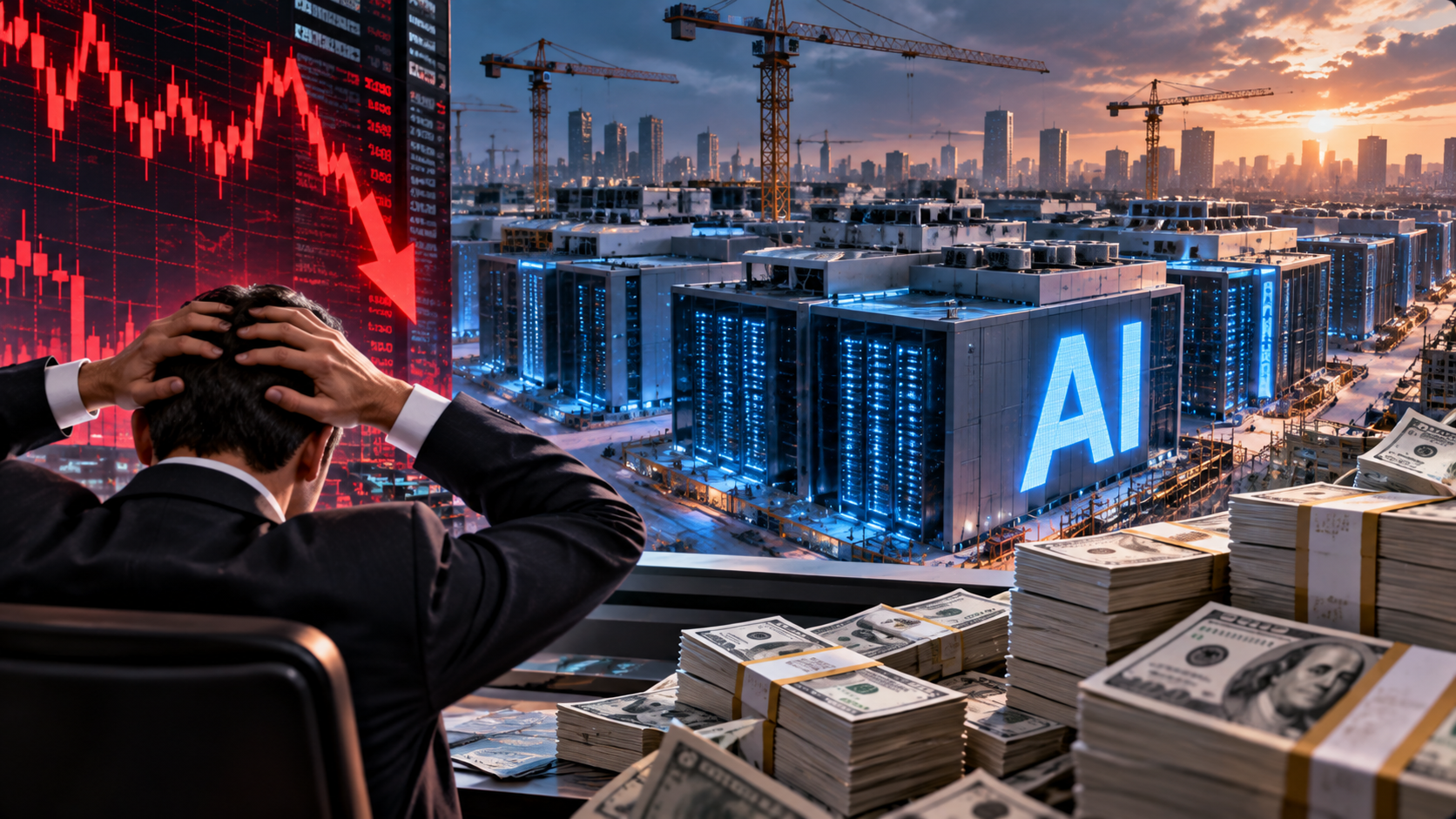
The artificial-intelligence investment boom is becoming a broader financial-market risk as major technology companies turn increasingly to outside financing for infrastructure spending.
An estimate by Columbia Business School Professor Stijn Van Nieuwerburgh places cumulative AI-related infrastructure investment at US$10.3 trillion by 2032. His paper said that would equal 3.6 per cent of annual US economic output for the next 7 years.
The spending is already unusually large. The leading US technology and cloud companies, often called hyperscalers, are expected to commit more than US$750 billion to capital investment this year as they compete for dominance in AI.
That scale has helped make AI a central economic and investment theme since ChatGPT launched in November 2022. It has also supported global markets during a period marked by severe shocks. Equity markets are at a record high, global economic growth is at its fastest pace since May 2023 and corporate earnings have increased sharply.
Why the AI trade matters beyond technology
The current investment cycle extends beyond AI. Defence spending and efforts to build more resilient supply chains are also contributing to capital expenditure. In a September 25 report, Deutsche Bank's George Saravelos described the global capital expenditure cycle as the “superglue holding the market together”.
The International Monetary Fund said on October 13 that it had underestimated global growth for three consecutive years, mainly because of the “positive demand shock” created by AI. On the same date, Bank of America's global fund manager survey showed investors holding their largest technology-sector overweight position since August 2020.
The central economic question is whether demand from end users will grow quickly enough to justify the money being committed. The buildout also faces constraints, including opposition to new data centres in some countries and increasing calls for regulation.
Yet the more immediate danger may lie in how AI spending is reshaping financial markets. Alliance Bernstein described AI as “the everything trade”, saying its demand for capital was creating connections across asset classes and making diversification more difficult.
Debt is widening the exposure
Concerns about concentration initially focused on stock markets. They now extend into bonds and credit as hyperscalers' free cash flow declines and the companies seek external funding.
According to IMF data, hyperscalers represent nearly 10 per cent of total investment-grade corporate bond issuance, compared with 0.5 per cent in 2024. Morgan Stanley estimates that credit and corporate debt markets will provide roughly half of global capital expenditure for data centres through 2028.
That financing shift creates additional vulnerability. If investors treat AI infrastructure as a dominant growth bet, a reversal could affect several markets at the same time rather than technology shares alone.
The potential impact is greater because the AI ecosystem is becoming more leveraged. A sustained, disorderly retreat from the trade would be more damaging than it might have been a year earlier, particularly if confidence in the technology's ability to generate returns weakens.
Warning signs and limits to the risk
The major US hyperscalers have strong balance sheets and substantial liquidity buffers. However, the increase in AI-related debt could still transmit stress to wider markets, especially as stock-market leverage has grown alongside higher interest rates.
South Korea offers a recent warning about leverage-driven market losses. Its semiconductor-led stock market was the best-performing major market during the first half of this year, but it has fallen around 34 per cent since June 22 and became the weakest performer among its peers in the second half.
Other pressures are also building. AI-related pessimistic scenarios are becoming more common, while Chinese AI model usage exceeded US platforms globally for the first time in June. Van Nieuwerburgh has warned that long-term debt and contractual claims are being created against assets with unusually uncertain use, technological relevance and remaining value.
Global fund managers identified hyperscalers' capital spending as the most likely source of a “systemic credit event”. That view signals concern about the concentration of risk, not proof that a crisis is about to begin.
Conclusion
The AI boom remains a major source of investment, growth and market support, but its growing reliance on debt has increased the possibility of spillovers. A crisis is not imminent, yet the scale of the bet and the uncertainty surrounding its underlying assets have made a disorderly reversal a serious financial risk.
Frequently Asked Questions
Q. How large could AI infrastructure investment become?
Professor Stijn Van Nieuwerburgh estimated cumulative investment could reach US$10.3 trillion by 2032.
Q. How much are US hyperscalers investing this year?
The major US hyperscalers are expected to spend more than US$750 billion on capital investment this year.
Q. Why has the risk spread beyond technology stocks?
Hyperscalers are increasingly using external finance, linking AI investment to corporate bonds and credit markets.
Q. What share of investment-grade corporate bond issuance do hyperscalers represent?
IMF data puts their share at nearly 10 per cent, up from 0.5 per cent in 2024.
Q. Is a financial crisis considered imminent?
No. The assessment is that a crisis is not imminent, although the scale and leverage of the AI investment boom have increased the potential danger.
Q. What happened in South Korea's stock market?
The semiconductor-led market fell around 34 per cent since June 22 after being the best-performing major market during the first half of this year.