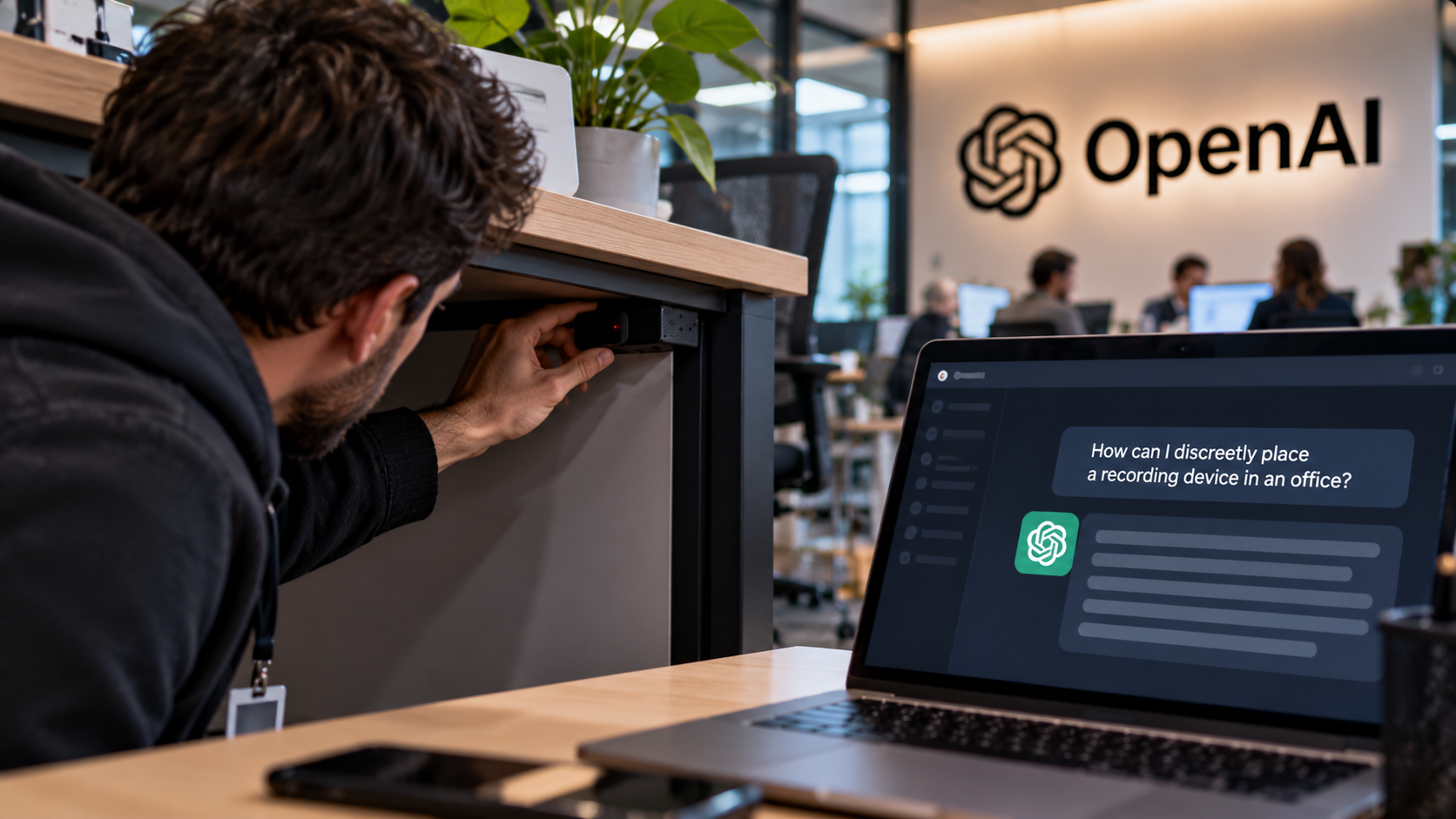
An OpenAI engineer allegedly used chatbot tools while planning to place a covert recording device in a conference room reserved for executives, according to federal prosecutors and a court complaint.
Abdulrahman Alfozan, whom prosecutors describe as a 35-year-old Saudi Arabian national and US permanent resident, made an initial appearance in US district court in San Francisco on Tuesday. He faces one charge involving the alleged interception of oral communications.
The charge concerns an alleged device discovered by OpenAI during a countersurveillance sweep. If convicted, Alfozan faces up to 5 years in prison. He could not be immediately reached for comment.
What prosecutors allege
Prosecutors say Alfozan spent several weeks asking an unspecified “productivity agent” and an “AI chatbot” questions connected to the alleged operation. He also used an internal OpenAI tool to check meetings scheduled in the targeted room.
A chatbot account associated with his spouse was allegedly used for technical questions about setting up a covert audio recording device. The supplied material does not identify the chatbot or provide the full contents of those queries.
The complaint alleges that the device was planted “no later than on or about September 28, 2026.” OpenAI discovered it on September 30 during a security sweep, according to the reported account.
Authorities allege the device was a Seeed XIAO ESP32-S3 Sense, described as a thumb-sized development board with a detachable camera sensor, digital microphone and microSD storage. OpenAI called the device “sophisticated.” The company's security team tried to export the microSD card's data but could not review it because the files were encrypted.
The device was allegedly concealed in toilet paper and inserted into a USB port on the back of a television in the conference room.
Why the room mattered
The room could be reserved only by executives and executive assistants, according to the complaint. It was used for internal leadership meetings, technical and product sessions, and external briefings involving business partners and government officials.
The complaint said discussions there could involve highly confidential information about research, products, business strategy and government relationships. FBI director Kash Patel said Alfozan aimed “to secretly capture sensitive communications about the company's super intelligence technology.”
Prosecutors and OpenAI have not provided information about a possible motive. OpenAI said it had no indication that Alfozan improperly accessed or exfiltrated model weights, source code or customer data.
The company said it notified the FBI after finding the device. OpenAI linked it to Alfozan through chat logs and surveillance footage, then searched a bag he had left unattended at the office. His access to company systems was gradually disabled during the investigation.
Second device found in office bag
OpenAI security personnel found the unattended bag in a printer room on October 5, according to the complaint. It contained another encrypted Seeed listening device and personal items linked to Alfozan, including his wallet.
Prosecutors say Alfozan later reported the bag missing and recovered it from the company's lost and found. He subsequently told unnamed OpenAI personnel that several items were missing, including a credit card, about $500 in cash and two AirPods.
The complaint says he did not mention the second listening device, which OpenAI security had removed from the bag.
Alfozan joined OpenAI in July 2025 and was fired last Friday to coincide with his arrest. Before joining the company, he reportedly worked at a cargo logistics startup and Meta. A purported LinkedIn profile also lists him as a part-time venture partner at RAED Ventures, a Saudi Arabia-based venture capital firm.
In a recent podcast interview, Alfozan said he belonged to a group of Saudi engineers in Silicon Valley that provided consulting services to Saudi organisations. Neither RAED Ventures nor Meta immediately responded to a request for comment.
The reported case comes after the Trump administration signed a pact with Saudi Arabia last year granting the kingdom access to advanced chips and AI technologies that might otherwise face national-security restrictions. Saudi investment firms remain a major source of capital for US technology companies.
Conclusion
The verified allegations concern a covert recording device, chatbot-assisted planning, a second encrypted device and a federal interception charge. OpenAI says it has found no indication of improper access to model weights, source code or customer data.
Frequently Asked Questions
Q. Who is accused in the case?
Abdulrahman Alfozan, whom federal prosecutors describe as a 35-year-old Saudi Arabian national and US permanent resident, is accused.
Q. What is he charged with?
He faces one charge involving the alleged use of an electronic, mechanical or other device to intercept oral communications.
Q. Where was the first device found?
It was found in an OpenAI conference room used for executive meetings, technical and product sessions, and external briefings.
Q. When was the device allegedly planted?
The complaint alleges it was planted no later than on or about September 28, 2026. OpenAI discovered it on September 30.
Q. What type of device was allegedly involved?
Authorities identify it as a Seeed XIAO ESP32-S3 Sense development board with a camera sensor, digital microphone and microSD storage.
Q. Was a second device found?
Yes. OpenAI security personnel allegedly found another encrypted Seeed listening device in a bag left unattended at the office.
Q. Did OpenAI report improper access to its data?
OpenAI said it had no indication that model weights, source code or customer data were improperly accessed or exfiltrated.