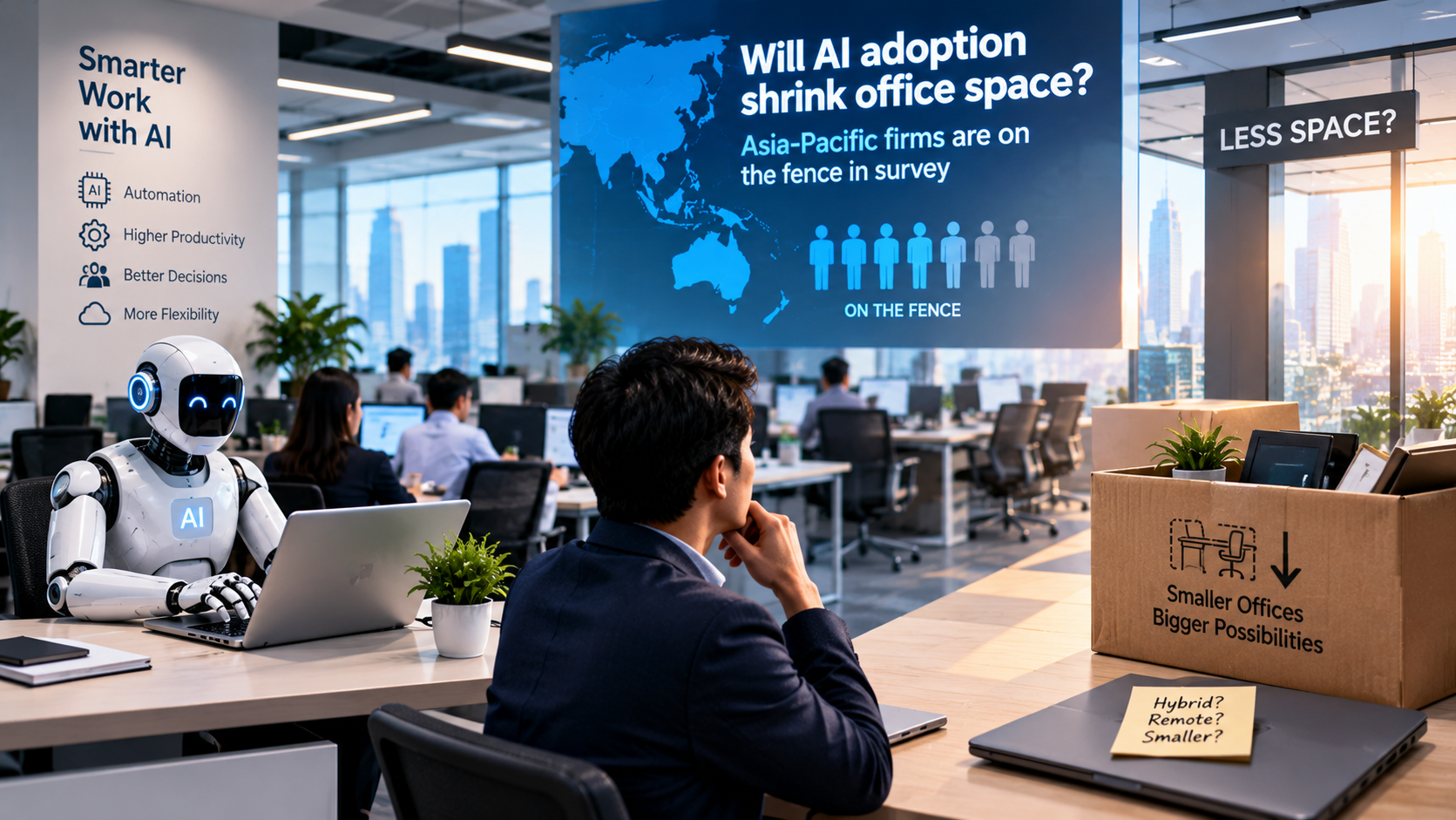
Artificial intelligence (AI) is influencing office operations in Asia-Pacific more clearly than it is changing companies’ property requirements, according to a CBRE survey of corporate real estate executives. The findings suggest that most businesses have not yet decided whether broader AI use will lead to smaller or larger office portfolios.
Nearly one-fifth of respondents said wider AI adoption would reduce their real estate needs. A further 25 per cent expected to expand their office footprint. The largest group, 56 per cent, took a neutral position, saying AI had either not affected office space demand or that it was too early to assess the consequences.
The survey covered 651 responses from 9 markets between May 26 and July 10. They included Hong Kong, mainland China, Singapore, Japan, Australia and India. Responses from mainland China and India received greater weighting to reflect those markets’ share of Asia-Pacific grade A office stock.
AI’s immediate effect remains limited
CBRE said the results point to a stronger current impact on workplace operations than on real estate requirements. Ada Choi, the consultancy’s head of research for Asia-Pacific, said organisations were mostly still evaluating the consequences of AI and that its short-term effect on property needs remained minimal.
Choi also said many occupiers remained confident about business growth and continued to plan for expansion. As businesses review their office portfolios, she said future growth would be focused on higher-quality workplaces, while lower-value space would be rationalised.
The survey found that 46 per cent of respondents identified as AI adopters or active movers in applying the technology to corporate real estate operations. That compared with 9 per cent in 2024, indicating a sharp rise in the number of organisations using or advancing AI-related initiatives in property operations.
Office attendance stays elevated
The findings on AI came alongside evidence that office attendance has stabilised at relatively high levels. Nearly 9 in 10 respondents said employees worked from the office at least 3 days per week, the highest level recorded since the Covid-19 pandemic. Another 85 per cent said office attendance had reached a steady state.
Tom Gaffney, CBRE’s head of leasing for Asia-Pacific, said companies were no longer focused only on bringing employees back to offices. With attendance and utilisation largely stabilised, he said businesses could concentrate on improving workplace experience and efficiency.
Gaffney described the shift as a new equilibrium for the office market. Companies are selectively growing their portfolios and giving priority to premium workplaces, rather than treating AI as an immediate reason to reduce office capacity across the board.
Workforce concerns and property decisions
AI has been linked to layoffs across several sectors, with smaller workforces often associated with lower office requirements. A World Economic Forum study last year found that 41 per cent of employers across 22 industries in 55 economies planned to reduce their workforce as AI automated certain tasks.
The CBRE findings, however, indicate that potential workforce changes have not yet translated into a broad regional pullback in office demand. Most surveyed organisations remain neutral about AI’s property effect, while a larger share expects expansion than contraction among the respondents who have formed a clear view.
# What the survey indicates
- AI adoption is advancing in corporate real estate operations, but its effect on total office requirements remains uncertain.
- Companies are continuing to assess how technology, business growth and workplace use will affect their portfolios.
- Higher-quality workplaces are expected to attract future investment, while lower-value space faces rationalisation.
- Office attendance and utilisation have stabilised at levels that support continued attention to workplace upgrades.
Conclusion
The CBRE survey points to a gradual reshaping of Asia-Pacific offices rather than an immediate AI-driven reduction in space. Companies are still weighing technology’s effect on demand, while prioritising efficient, higher-quality workplaces and maintaining relatively stable office attendance.
Frequently Asked Questions
Q. How many companies expect AI to reduce office needs?
Nearly one-fifth of surveyed companies said wider AI adoption would reduce their real estate requirements.
Q. How many respondents were neutral about AI’s effect on offices?
56 per cent said AI had no current effect on office demand or that it was too early to determine the impact.
Q. How many companies expect to expand their office footprint?
25 per cent of respondents said AI adoption would require them to expand their office footprint.
Q. Where and when was the CBRE survey conducted?
The survey ran between May 26 and July 10 across 9 Asia-Pacific markets, including Hong Kong, mainland China, Singapore, Japan, Australia and India.
Q. How many responses did the survey receive?
CBRE received 651 responses from corporate real estate executives.
Q. What is the current effect of AI on office property decisions?
CBRE said AI is currently having a more significant effect on office operations than on real estate requirements.
Q. Are employees still working from offices regularly?
Nearly 9 in 10 respondents said employees worked in the office at least 3 days per week, while 85 per cent said attendance had reached a steady state.
Q. How many respondents were applying AI to corporate real estate operations?
46 per cent identified as AI adopters or active movers, compared with 9 per cent in 2024.