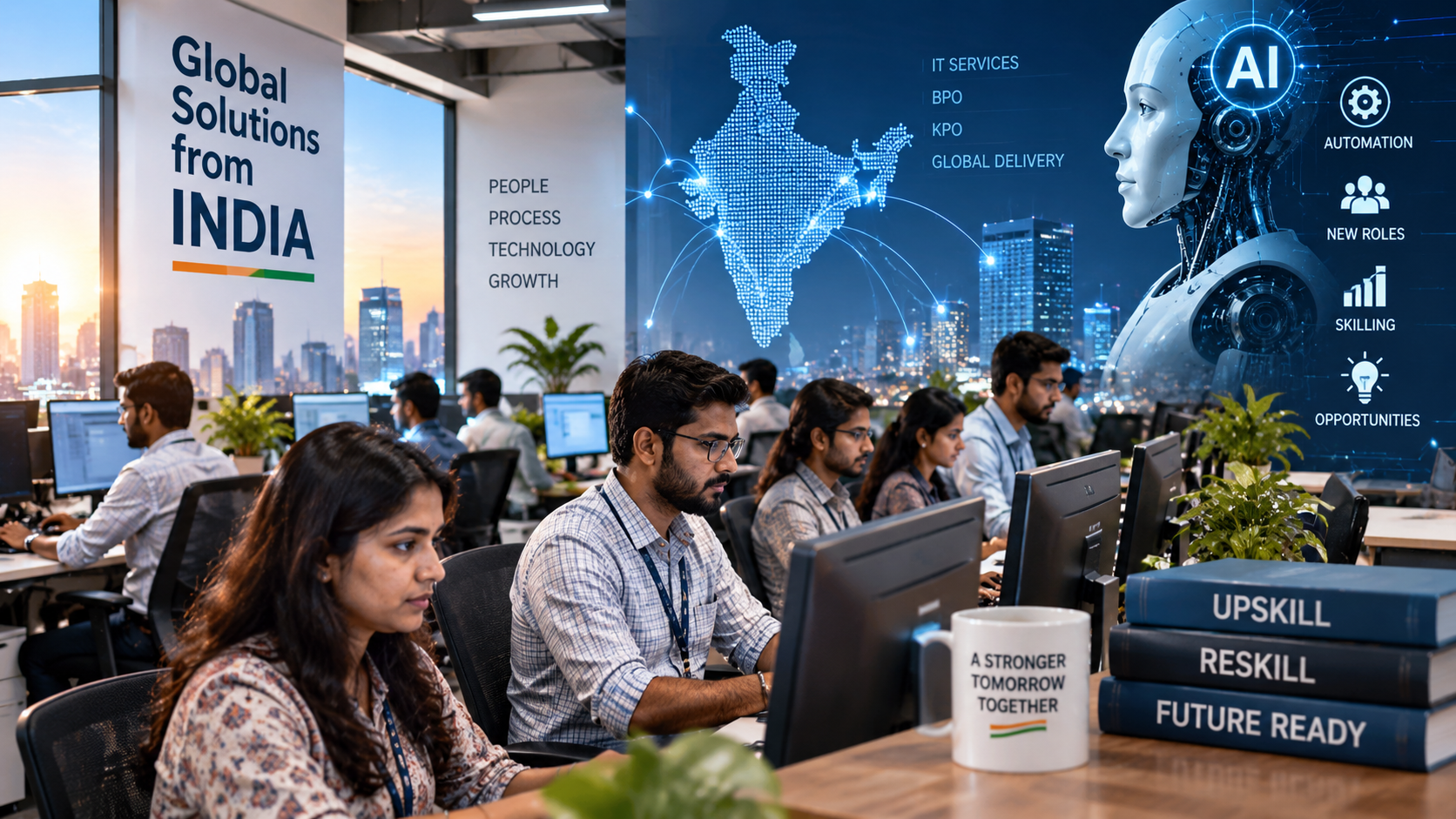
India’s outsourcing industry is shifting toward more complex services rather than losing ground to artificial intelligence, ING Bank NV said. The change is moving demand away from repetitive work and toward areas such as analytics, software development, risk management, engineering design and research and development.
Software services exports now account for roughly 5.2 per cent of India’s gross domestic product, compared with 3.3 per cent before the pandemic, according to an ING note by economist Deepali Bhargava. Business services, including finance, accounting, engineering, research and analytics, have more than doubled their share to 3.3 per cent over the same period.
Why the industry is holding up
The figures challenge concerns that generative AI could weaken one of India’s most important industries by automating work traditionally sent to lower-cost markets. India commands more than half of the global outsourcing industry and earns around $205 billion annually from software services exports, according to ING. Those exports support about 5.8 million workers.
Software and business services exports together are equivalent to about 8.5 per cent of GDP. They also provide an important source of foreign exchange, making the sector significant beyond its direct contribution to employment and services revenue.
“AI disruption fears look premature in India and the Philippines,” Bhargava wrote. “The evidence points to adaptation, not decline. AI is reshaping what gets outsourced, not shrinking demand for it.”
Work is moving up the value chain
Growth is moving away from data entry, document verification and customer support. In their place, companies are seeking services that require more specialised capabilities, including analytics and software development.
India is also seeing strong demand for risk management, engineering design and research and development. This shift suggests that artificial intelligence is changing the type of work handled by outsourcing providers rather than eliminating the need for external service delivery altogether.
The transition is also visible in export performance. India’s digitally delivered services exports have grown 45 per cent since 2022, compared with 32 per cent globally, allowing the country to gain market share, ING said.
What the numbers mean for workers and businesses
The industry’s growing contribution to GDP indicates that software and business services remain an expanding part of India’s economy. For workers, the change places greater emphasis on capabilities linked to higher-value services, while businesses are increasingly outsourcing work that involves specialised analysis, technology and professional expertise.
The figures do not indicate that every existing role is protected from automation. They show that demand is being redirected toward different categories of work, with repetitive processes facing pressure and more complex services gaining importance.
Conclusion
ING’s assessment is that India’s outsourcing industry is adapting to artificial intelligence through a shift toward higher-value services. Export growth, rising GDP shares and continued demand for specialised work point to an industry being reshaped rather than reduced.
Frequently Asked Questions
Q. Is AI shrinking India’s outsourcing industry?
ING’s assessment is that AI is changing the type of outsourced work rather than reducing overall demand.
Q. What share of GDP do software services exports represent?
Software services exports account for roughly 5.2 per cent of India’s GDP, compared with 3.3 per cent before the pandemic.
Q. Which outsourcing jobs are growing?
Demand is increasing for analytics, software development, risk management, engineering design, research and development, finance and accounting services.
Q. How many workers do software services exports support?
The sector supports about 5.8 million workers, according to ING.
Q. How fast have India’s digitally delivered services exports grown?
They have grown 45 per cent since 2022, compared with 32 per cent globally.
Q. How much does India earn from software services exports?
India earns around $205 billion annually from software services exports.
Q. What types of work face pressure from AI?
Repetitive tasks such as data entry, document verification and customer support are shifting as demand moves toward more specialised services.