China’s AI developers have found a way around the country’s limited access to the world’s most powerful processors: they have rented capacity in overseas data centres and used cloud networks to train advanced models on Nvidia chips.
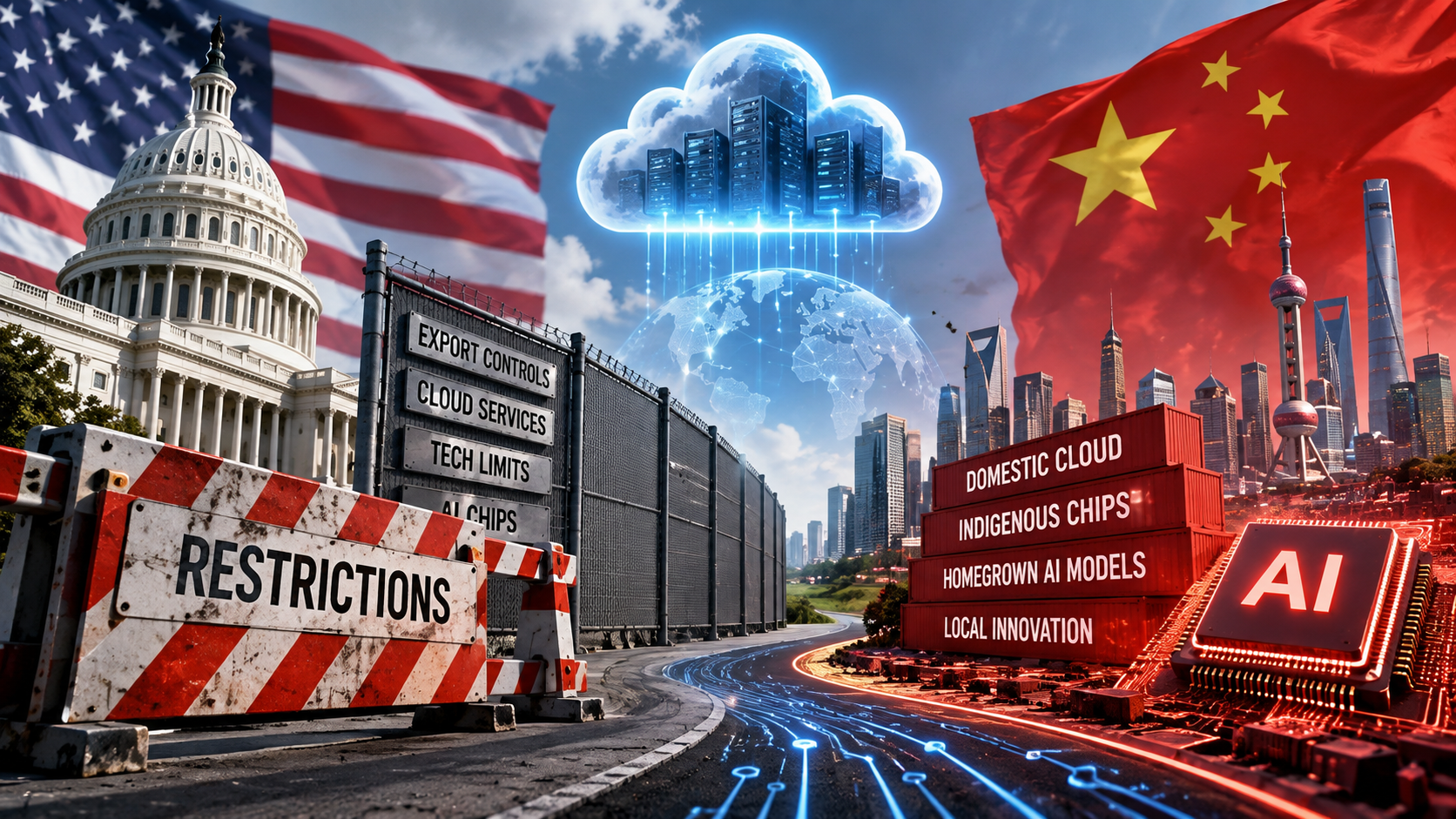
That workaround could soon disappear. Washington is reportedly considering restrictions on foreign remote access to cloud computing, while US agencies review the leasing arrangements that have allowed Chinese companies to use Nvidia-powered servers outside mainland China. The proposed shift would extend the pressure beyond physical chip shipments and create a new constraint for China’s frontier AI sector.
How the overseas route works
Chinese technology groups and start-ups have used proxy entities and contracts signed by non-Chinese companies to lease servers in Southeast Asia, Japan and the Middle East, according to a Shenzhen data-centre broker. Some teams have taken unusual steps to move data, including carrying hard drives containing 80 terabytes from Beijing to Malaysia for model training.
Other reported arrangements involved blockchain-based smart contracts and cryptocurrency payments designed to keep counterparties behind anonymous digital wallets. The practice has also contributed to overseas demand for Nvidia hardware, according to Arisa Liu of Taiwan Industry Economics Services.
The pressure is already visible in rental prices. Nebius Group raised prices for some Nvidia chips by roughly 30 per cent in June, with a further 21 per cent increase scheduled for October 1. Rental rates for Nvidia A100 processors reached US$3.75 per hour in late August, compared with US$3.71 a month earlier, according to Silicon Data.
Southeast Asia faces a market shock
A US clampdown would immediately affect Southeast Asia, one of the fastest-growing data-centre regions. Capacity there was projected to expand by 35 per cent each year from 2023 through 2028, against a global average of 15 per cent.
Alibaba Group Holding, Tencent Holdings and ByteDance have built regional infrastructure partly because of lower development and operating costs, as well as available land and power. The region has also attracted workloads from Chinese internet and cloud companies because some accelerator architectures are unavailable in mainland China.
Analysts expect any disruption to create a temporary imbalance between supply and demand rather than a lasting collapse. Released capacity could be absorbed by other customers because demand for AI computing remains strong.
China’s domestic hardware gap
The bigger challenge is inside China. The B200, B300, H100 and H800 remain unavailable there, while H200 imports have been approved by Washington and Beijing but remain limited. ByteDance and Tencent each received about 10,000 H200s, according to the Financial Times, far below the tens of thousands or more than 100,000 advanced graphics processing units that major technology companies can require.
Nvidia said H200 shipments to China represented less than one per cent of its US$89 billion data-centre revenue in the quarter ending July 26. The company did not expect data-centre computing revenue from China in the following quarter.
Chinese companies are therefore pushing domestic alternatives. Meituan said its LongCat-2.0 model, with 1.6 trillion parameters, was trained and run on a 50,000-card domestic computing cluster. Huawei’s Ascend 960DT, designed for model training, is scheduled to be ready in the first quarter of 2027.
The cost of switching chips
Moving workloads from Nvidia to Chinese processors is not straightforward. Nvidia’s CUDA software platform remains an industry standard, and migrating workflows to Huawei’s Ascend chips could increase training time and cost by at least 50 per cent, researcher James Wang said.
China’s advanced-node wafer supply is projected to grow by 46 per cent annually from 2025 to 2035, compared with expected domestic demand growth of 17 per cent. Goldman analysts said that could reduce the supply-demand gap to 34 per cent by 2035 from 92 per cent in 2025.
Legal uncertainty
The US House passed the Remote Access Security Act in January. If it becomes law, it would extend US export controls to remote cloud-computing access. Legal expert Hong Jiayang said there are currently no rules specifically prohibiting the arrangements, while the Biden administration’s AI Diffusion Rule, introduced in January 2025, was later rescinded by the Bureau of Industry and Security after Donald Trump returned to power.
Hong also said the Bureau could theoretically penalise data centres or model developers under General Prohibition 10 if they knowingly participated in transactions involving illegally smuggled chips. Any final restrictions could affect cloud providers including Oracle and Amazon.com, while Nvidia’s sales growth could also be curtailed.
Conclusion
Restrictions on overseas cloud access would remove an important training route for Chinese AI developers. The immediate effects could spread through Southeast Asian data centres and Nvidia’s international business, while the longer-term result would likely be stronger pressure on China to improve its domestic chips and software ecosystem.
Frequently Asked Questions
Q. Why do Chinese AI companies use overseas cloud data centres?
They use overseas servers to access advanced Nvidia processors that cannot legally be bought in China.
Q. What could the proposed US restrictions change?
They could extend export controls from physical chips to remote access to cloud computing resources.
Q. How could Southeast Asia be affected?
Data centres could temporarily face an imbalance between supply and demand if some Chinese workloads are removed, although other customers may absorb released capacity.
Q. Which Nvidia chips are unavailable in China?
The B200, B300, H100 and H800 are unavailable in China, while H200 imports are allowed in limited quantities.
Q. What is China doing to reduce its reliance on Nvidia?
Chinese companies are developing and deploying domestic chips, including Huawei’s Ascend systems, for AI training and inference.
Q. Why is switching from Nvidia difficult?
Existing AI workflows rely heavily on Nvidia’s CUDA software platform, and migration to Huawei’s Ascend chips could raise training time and cost by at least 50 per cent.
Q. When is Huawei’s Ascend 960DT expected?
Huawei said the training-focused chip will be ready in the first quarter of 2027.
Q. Could the restrictions affect Nvidia’s revenue?
Arisa Liu said restrictions on cloud leasing could limit Nvidia’s sales growth, although stronger orders from other international technology companies could partly offset the effect.