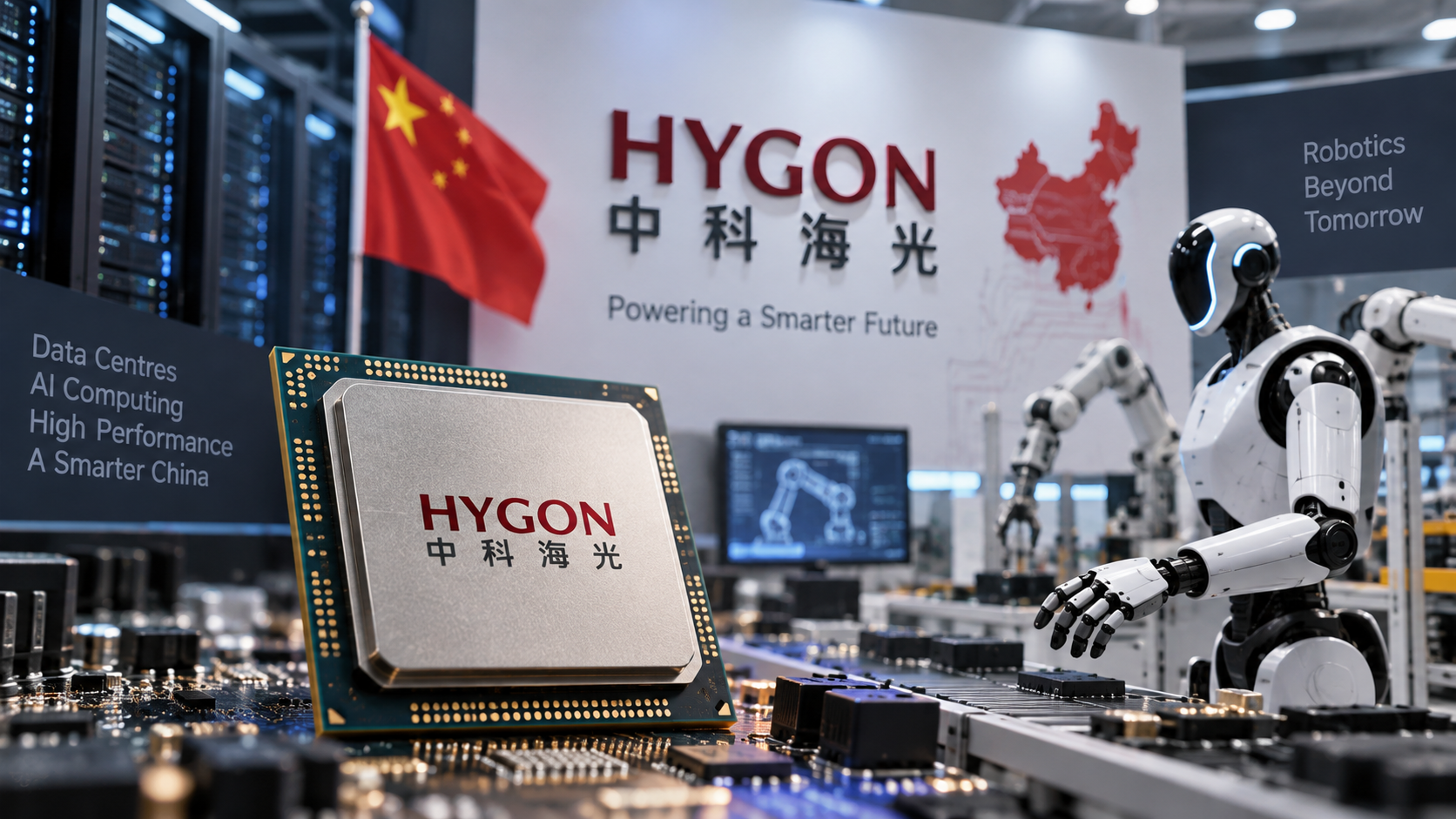
Hygon Information Technology is preparing to launch a new chip for physical artificial intelligence applications, taking the Chinese semiconductor company beyond its established data-centre market. The CPU1000-series product is aimed at machines that need to process information while operating directly in the physical world.
The launch is scheduled for Tuesday in Shenzhen, a southern technology hub. Hygon has promoted the event under the slogan “Let computing power reach the physical world”, but has not disclosed further product details.
Target applications
Reports by Jiemian News and China Securities Journal say the chip is designed around low-power, embedded and edge computing requirements. Its target uses include robotics, machine vision and intelligent manufacturing.
These applications place computing hardware at or near the location where machines work. That differs from the company’s current emphasis on data centres, where processors are generally used for centralised computing workloads.
Chips for robotics and other edge systems must handle real-time processing, operate within power limits and maintain robust security in unpredictable environments. The new product therefore places Hygon in a chip category shaped by the needs of physical machines rather than data-centre capacity alone.
Hygon’s existing portfolio
Hygon designs central processing units and deep computing units, which are accelerator cards developed specifically for artificial intelligence. Its CPU range currently includes the 7000 series for high-performance data centres, the 5000 series for middle-level industry customers in cloud and edge computing, and the 3000 series, which focuses on cost efficiency.
The Shanghai-listed company is one of China’s leading developers of x86-compatible CPUs. The x86 architecture, originally developed by US semiconductor company Intel, remains the basis for most server, desktop and laptop computers.
Hygon’s expansion comes as computing demand moves from centralised data centres towards network edges at active industrial sites. This shift is increasing the importance of processors that can support machines and equipment where they operate, rather than sending every task back to a central facility.
Revenue and semiconductor strategy
The company is also part of Beijing’s wider push for semiconductor self-sufficiency. Hygon’s first-half revenue rose 66.5 per cent from a year earlier to 9.1 billion yuan, equivalent to US$1.4 billion, supported by strong demand for high-end domestic chips.
The upcoming product will show how Hygon applies its processor expertise to physical AI markets. The company has identified the target sectors and the chip’s computing requirements, while additional technical information has not been disclosed.
Conclusion
Hygon’s CPU1000-series launch marks its move from a primarily data-centre-focused portfolio towards chips for robotics, machine vision and industrial edge computing. Its next step is the Tuesday event in Shenzhen, where further product details may be announced.
Frequently Asked Questions
Q. What is Hygon launching?
Hygon is preparing to launch a CPU1000-series chip for physical artificial intelligence applications.
Q. Which industries will the chip target?
The target areas include robotics, machine vision and intelligent manufacturing.
Q. Where will the launch take place?
The launch event is scheduled to take place in Shenzhen.
Q. How is the new chip different from data-centre chips?
It is designed for low-power, embedded and edge computing, where machines need real-time processing close to their operating environments.
Q. What CPU series does Hygon already offer?
Its current lines include the 7000 series for high-performance data centres, the 5000 series for middle-level industry customers, and the 3000 series focused on cost efficiency.
Q. How much did Hygon’s first-half revenue grow?
First-half revenue increased 66.5 per cent year on year to 9.1 billion yuan, or US$1.4 billion.