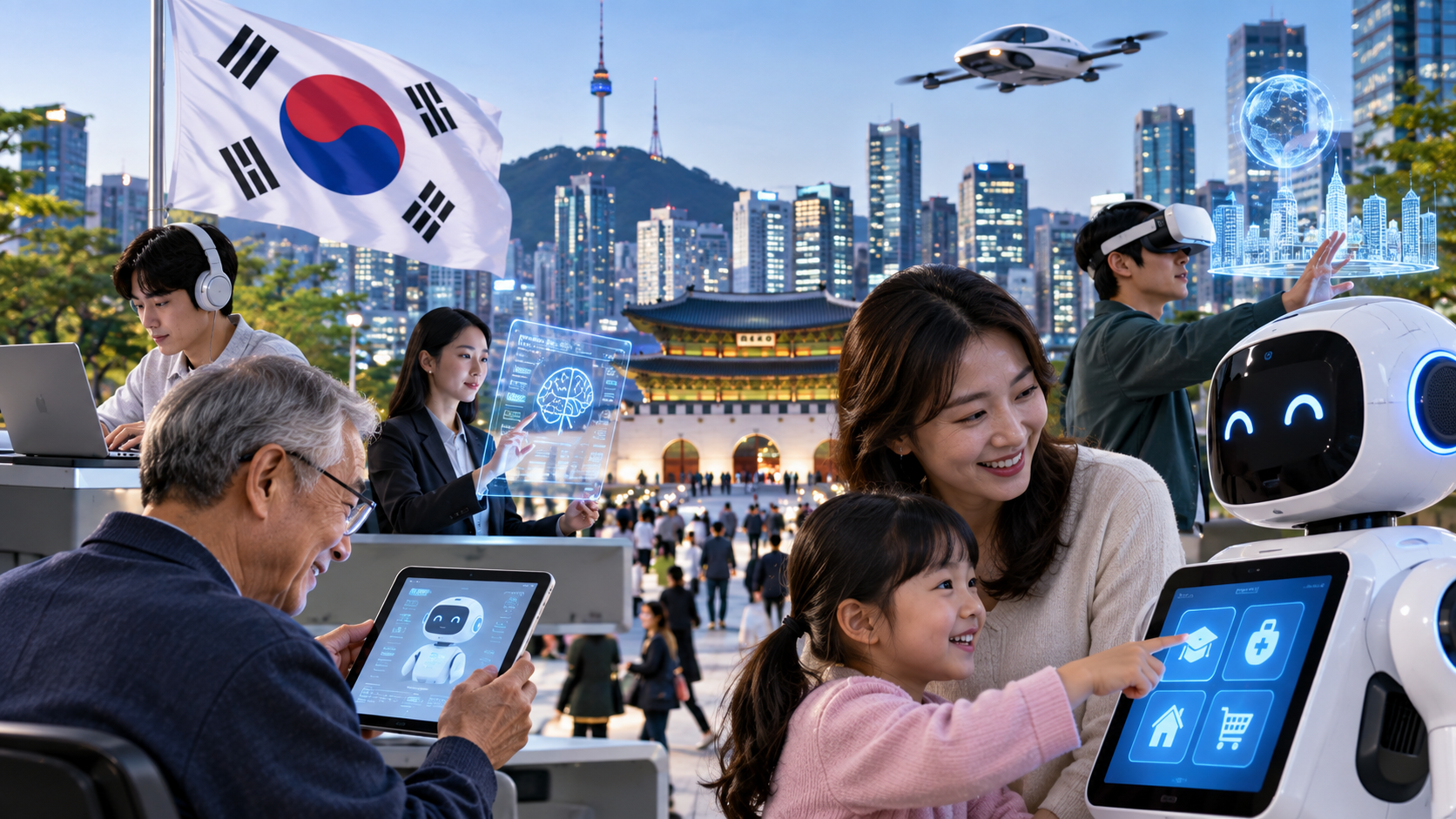
South Korea is preparing to make artificial intelligence (AI) freely available to every citizen, placing chatbots and AI agents at the centre of public services, education, healthcare and everyday tasks.
The initiative, led by President Lee Jae Myung, is intended to reduce the gap between people who can afford advanced AI tools and those who cannot. Seoul’s Ministry of Science and ICT said the objective was to spread the benefits of the technology rather than leave them concentrated among a limited group of users.
The programme is also a major test of whether a government can turn AI into a public utility while managing its effects on employment, crime, education and privacy.
How the public AI service will work
A beta version is scheduled to launch later this month. It will offer free, unlimited access to general-purpose chatbots and AI agents developed by 3 consortiums led by SK Telecom, KT and Kakao.
The companies are using hundreds of Nvidia B200 graphics processing units provided on loan by the government. Officials intend for the initial trial to become a permanent, taxpayer-funded service from next year.
In the longer term, citizens could use AI intermediaries to book medical appointments, search for homes and obtain tax advice. The government has not described the service only as a chatbot platform; its broader ambition is to connect AI with public systems and daily administrative needs.
South Korea has set aside an additional 250 billion won for the roll-out through 2027. That funding comes on top of a 10 trillion won AI budget for the current financial year.
The government hopes the plan will help South Korea become one of the world’s 3 leading AI powers alongside the United States and China. It also sees AI as a possible response to a shrinking workforce and a tool for supporting the country’s export-focused economy.
Rules, oversight and national control
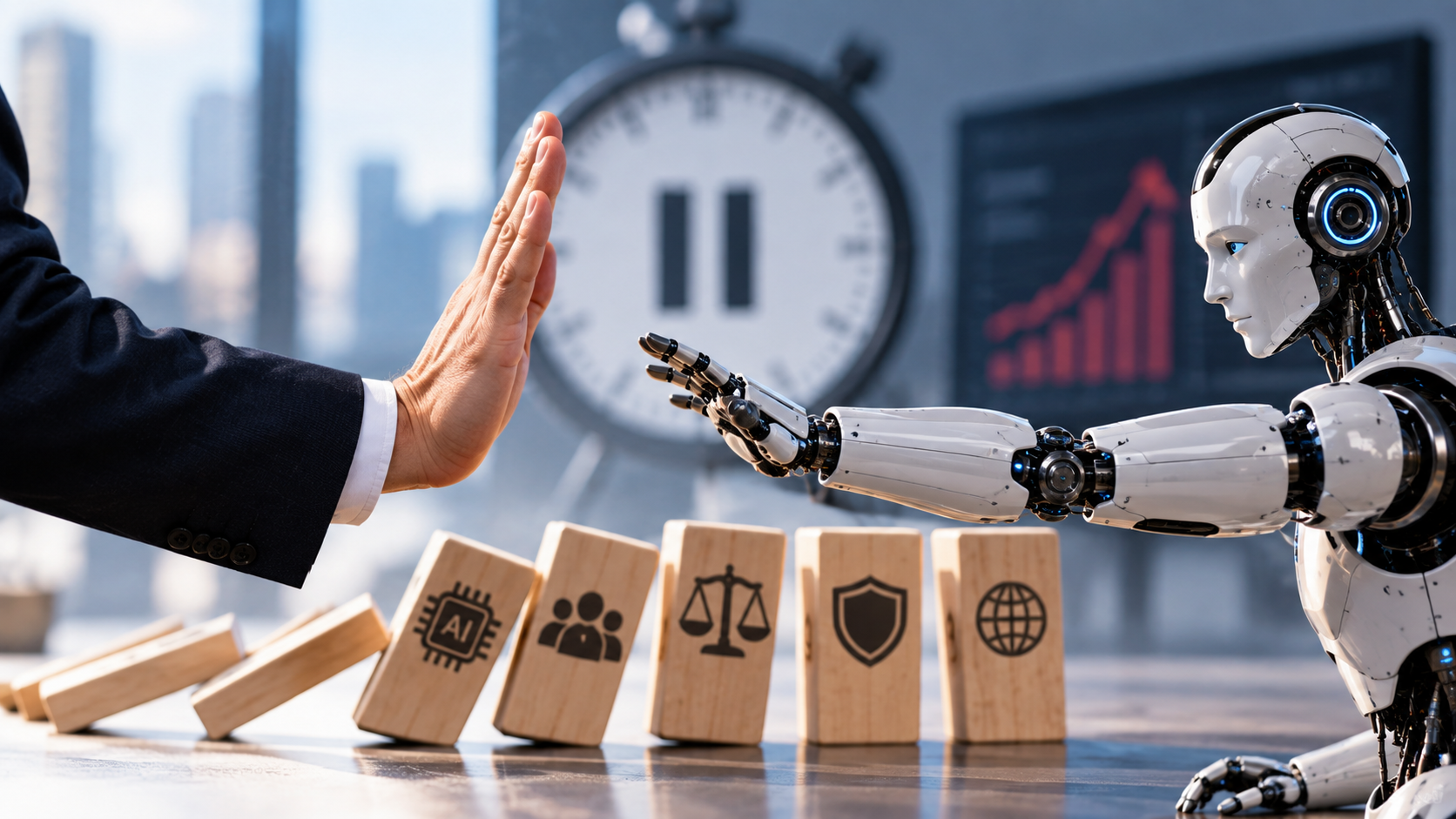
South Korea’s AI Basic Act, which came into force in January, is intended to provide safeguards for the initiative. The framework includes human oversight, impact assessments and clear watermarking for synthetic content.
A state-funded AI Safety Institute has been assigned a technical watchdog role. Its responsibilities include examining risks and helping ensure that public AI services remain secure, reliable and accountable to users.
The ICT ministry said the government plans to create an autonomous reliability-assurance system based on 7 AI Ethics Principles. Those principles include accountability, a human-centred approach, privacy protection and fairness.
National control is another reason Seoul is pursuing domestic AI services. Government figures show that roughly 2-thirds of South Korea’s 51.6 million people have tried or regularly use AI. Among them, 23.45 million are active users of OpenAI’s ChatGPT, 8.45 million use Google’s Gemini and 2.41 million use Anthropic’s Claude.
The ministry has warned that access to foreign services can change according to decisions by overseas governments or companies. In July, Science and ICT Minister Bae Kyung-hoon announced plans for a cybersecurity-focused domestic AI model by the end of this year after a US clampdown.
Businesses see gains, but question the models
At Unicup Coffee in Busan International Finance Centre, owner Bae Kyung-han says AI has helped his independent cafe compete with 11 low-cost chain rivals.
Bae began using generative AI about a year ago to produce promotional s and menu s. He now uses it for research, proposals, communications and advertising, and says the technology helped shift the business towards bulk orders rather than relying mainly on walk-in customers.
The cafe has 5 employees, serves about 13,000 people a month and records card sales that Bae says are roughly double those of competitors. He has also registered as a vendor with one of the government’s selected AI consortiums, teaching beginners how to write better prompts for chatbots.
Bae nevertheless doubts that free domestic models will automatically replace premium foreign services. He said experienced users might continue paying for tools such as ChatGPT unless South Korean systems offer specialised services built around particular business problems.
That question matters for the government’s public-service model. Free access may broaden participation, but usefulness will depend on whether domestic systems can provide capabilities that users consider competitive and relevant.
Employment fears are growing
At a jobs fair at Yonsei University in Seoul, electronic engineering student Kwon Il-geun said his ability to use AI tools had nearly doubled over the past year. He hopes to work for Samsung Electronics or SK Hynix and views AI skills as increasingly important for new graduates.
The employment picture for young people is less encouraging. The number of South Koreans aged 15 to 29 in work fell by 285,000 between June 2022 and June this year, according to the central bank. It estimated that 94 per cent of the decline occurred in sectors highly exposed to automation, including publishing, IT services and computer programming.
The Korea Development Institute projected in July that AI could eliminate roughly 256,000 jobs a year during the next decade. Enrolment has reportedly fallen at academies teaching graphic design and coding, while demand has increased for training linked to public-sector careers.
At Seoul’s SKY Entrance Exam Academy, enrolment in a military and policy preparation course is up 70 per cent year on year. Recent school leaver Yun Ji-sang is preparing for 5 years of officer training and a military career of at least 15 years, valuing the stability and pension associated with the path.
The number of young people in employment fell by 143,000 in August compared with the previous year, the Chosun Daily reported on September 9. That marked the 46th consecutive month of decline for the 15-to-29 age group. Separately, the Ministry of Personnel Management said nationwide civil-service recruitment increased this year for the first time in 5 years.
Seoul National University law professor Ko Hak-soo said generative AI had challenged earlier assumptions about which jobs were most vulnerable. Professional roles, particularly junior positions, may face increasing pressure even as jobs involving substantial human labour remain comparatively safer, he said.
Kim Myuhng-joo, executive director of South Korea’s AI Safety Institute, said companies were already using AI for coding and therefore hiring fewer junior developers. He also warned that people entering the workforce during the “AI for All” era might become too reliant on technology and fail to develop skills needed without it.
Deepfake crime remains a major concern
South Korea’s concerns are not limited to hypothetical risks from advanced AI. The country is dealing with criminal abuse of the technology, particularly sexually exploitative deepfake material.
The Nth Room case in 2020 and later scandals prompted South Korea to strengthen its deepfake laws in 2024. Producing such material can bring 7 years in prison or a 50 million won fine. Knowingly possessing or viewing it can result in 3 years in prison or a 30 million won penalty.
Police nevertheless recorded 1,553 deepfake-related offences last year. Those cases represented more than 35 per cent of reported cybersex crimes, according to figures presented at a forum hosted by Amnesty International Korea.
During the first half of this year, police apprehended 419 suspects for deepfake offences, including 17 who were physically detained while awaiting trial.
The National Office of Investigation said it was developing response technology, expanding forensic video expertise and using AI-assisted detection tools. Won Eun-ji, director of Team Flame, said she had spent much of this year investigating about 50 Telegram chat rooms with Newstapa and had seen AI expand the number of anonymous perpetrators and lower the age of victims.
Won said victims still provide many initial leads and argued that police need more specialised capabilities. Kim of the AI Safety Institute has supported impact assessments, possible undercover investigations and invisible watermarking to help trace AI-generated content to its creator or distribution route.
He has also called for platforms to take stronger steps against online crime and for children to receive AI literacy and education about these risks from primary school.
Schools are confronting a new learning problem
AI is also changing the balance between teachers and students. Moon Sung-ho, the 16-year-old editor-in-chief of the student newspaper Tokipul, said some pupils know more about AI than their teachers and use it to complete assignments.
Fifth-grade teacher Song Keun-sang was among educators who protested last year against the government’s short-lived 1.2 trillion-won plan for AI-powered textbooks. He said classroom use had shown him that the technology was less educationally useful than expected because it supplies answers without requiring students to develop understanding.
South Korean 15-year-olds recorded their lowest average reading score in 2025 since the country joined the OECD assessments in 2000, according to the OECD. They had topped the global reading rankings in 2006.
Song is concerned not only about academic performance but also about relationships. He said frequent reliance on chatbots could reduce cooperation and communication between students, skills that are needed later in working and social life. Moon has noticed classmates increasingly turning to AI instead of friends for help with schoolwork and other questions.
The debate is therefore not simply about whether AI can answer questions. It is also about whether constant access changes how young people learn, communicate and handle disagreement.
Conclusion
South Korea’s “AI for All” plan combines free public access with a national effort to build domestic technology and strengthen economic capacity. Its outcome will depend on whether oversight, education and policing can keep pace with the benefits and risks already appearing in workplaces, schools and online crime.
Frequently Asked Questions
Q. What is South Korea’s “AI for All” initiative?
It is a government plan to provide every citizen with free, unlimited access to general-purpose AI chatbots and agents, with possible links to public services.
Q. When will South Korea’s public AI beta launch?
The beta version is scheduled to launch later this month. Officials envisage a permanent taxpayer-funded service from next year.
Q. Which companies are developing the AI services?
Consortiums led by SK Telecom, KT and Kakao are developing the services selected for the initial roll-out.
Q. How much is South Korea spending on the initiative?
The government has allocated 250 billion won for the roll-out through 2027, alongside a 10 trillion won AI budget for the current financial year.
Q. What public services could people access through AI?
The planned uses include booking doctor appointments, searching for homes and receiving tax advice through AI intermediaries.
Q. What are South Korea’s main AI safety measures?
The safeguards include human oversight, impact assessments, synthetic-content watermarking and evaluation by the state-funded AI Safety Institute.
Q. How is AI affecting South Korean jobs?
Young employment has fallen in sectors exposed to automation, while the Korea Development Institute has projected roughly 256,000 AI-related job losses a year during the next decade.
Q. How serious is deepfake crime in South Korea?
Police recorded 1,553 deepfake-related offences last year, and 419 suspects were apprehended during the first half of this year.
Q. Why are educators concerned about AI in schools?
Some teachers say chatbots provide answers without enough educational value, while students and educators are also concerned about effects on reading, communication and relationships.