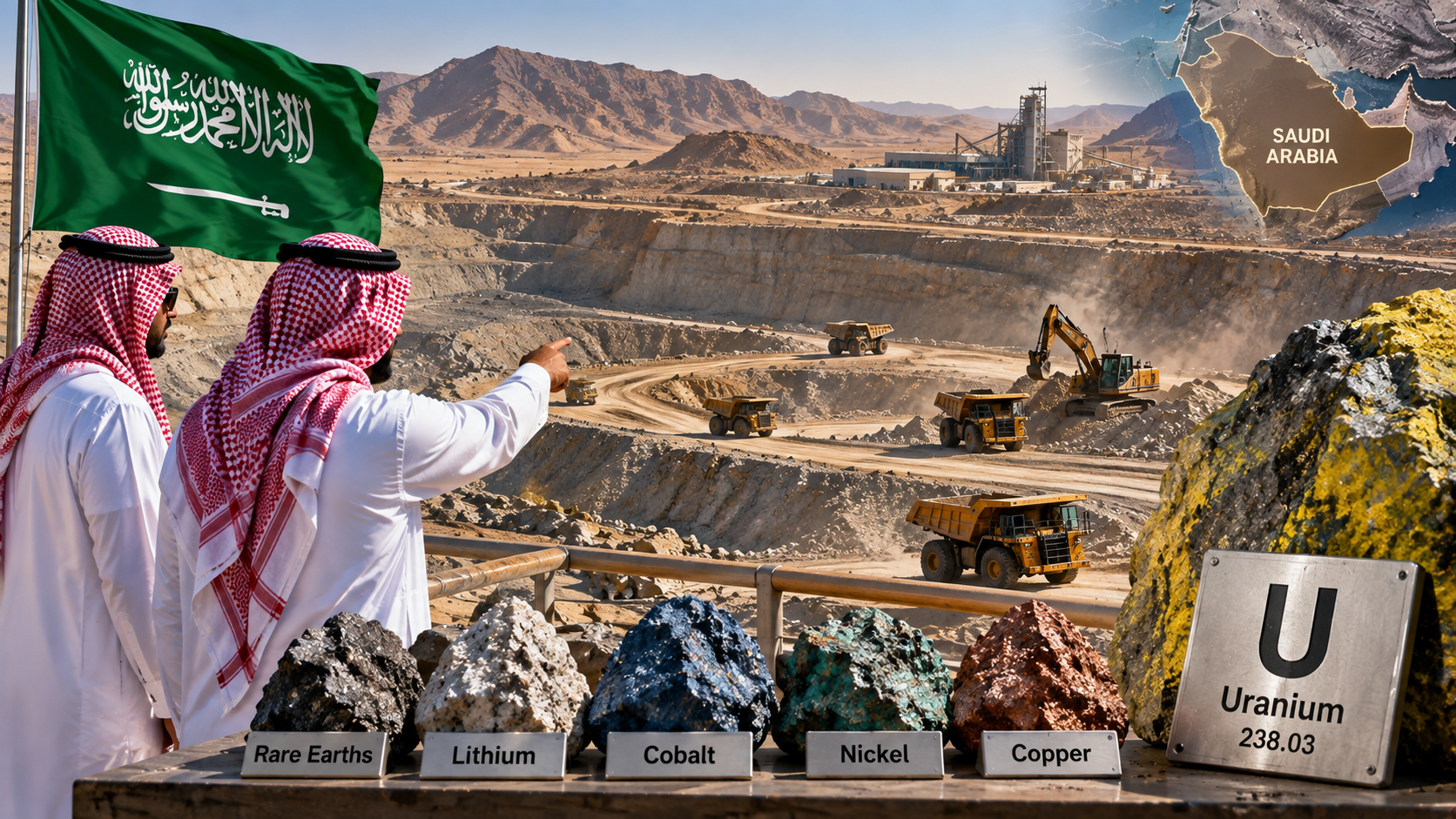
Saudi Arabia has reported a major mineral discovery in the Jabal Sayyid area of Medina, where surveys and geological studies identified about 110 million tonnes of raw ore containing rare earth minerals and uranium.
Energy Minister Prince Abdulaziz bin Salman announced the finding on Monday at an International Atomic Energy Agency conference in Vienna. He said the deposit could become one of the world’s significant sites for rare-metal development, although he did not give an exact uranium percentage.
Location and mineral potential
Jabal Sayyid is located in the Medina region, about 350 kilometres north-east of Jeddah. The area has previously been associated with rare-metal resources, but the latest studies have led to a higher estimate of the deposit’s scale.
The ore is reported to contain rare earth minerals, particularly substantial quantities of heavy elements. These materials are used in electronics, electric vehicles, wind power equipment and defence industries. Uranium is used as a raw material for nuclear energy.
The announcement therefore links 2 areas of strategic interest for Saudi Arabia: mineral development and the expansion of civilian nuclear power. The minister’s statement identified uranium quantities as promising, but did not establish the precise amount that could ultimately be extracted or used.
Saudi Arabia’s diversification plan
Saudi Arabia, the largest economy among Arab countries, has long depended heavily on oil. Under Vision 2030, the kingdom is seeking additional sources of income through mining, renewable energy and civilian nuclear energy.
The government has said it wants to diversify its energy mix rather than rely only on oil and gas. Solar, wind and nuclear power are included in that broader approach, alongside efforts to develop domestic mineral resources.
Domestic uranium production and an expanded civilian nuclear programme are part of this policy direction. The newly announced ore estimate gives greater importance to the country’s exploration work, while the absence of a disclosed uranium percentage means the commercial scale of that resource remains unclear.
National uranium exploration programme
The energy minister said Saudi Arabia is running a national programme to search for uranium. Another route under consideration involves recovering uranium from the acid produced during phosphate fertiliser production.
Saudi Arabia is among the major phosphate producers in the north. Tests have been conducted with French company Orano, and the economic indications from those trials have been described as positive.
That approach is separate from the Jabal Sayyid discovery, but both efforts fit within the kingdom’s wider attempt to identify domestic uranium resources and develop mining-related capabilities.
Link to US nuclear cooperation
The announcement comes after the United States and Saudi Arabia reached an agreement on civilian nuclear cooperation. The 2 countries signed that agreement alongside a bilateral security agreement in July.
The arrangement has been described as the foundation for a partnership expected to run for decades and involve billions of dollars. Under it, US companies will help develop Saudi Arabia’s civilian nuclear energy programme.
Reports said the agreement also gave Riyadh an option to enrich uranium on its own territory. That option was described as allowing scope for activity without US monitoring. Against that backdrop, the discovery of uranium in natural ore has significance beyond mining because it is connected to Saudi Arabia’s longer-term nuclear plans.
What remains unclear
The announcement establishes the estimated quantity of raw ore and identifies rare earth minerals and uranium within it. It does not provide an exact uranium concentration, a confirmed recoverable volume, a production timetable or a final investment plan for the deposit.
The next significance of the discovery will depend on further assessment of the resource and on how Saudi Arabia links the project to its mining, energy-diversification and civilian nuclear programmes.
Conclusion
Saudi Arabia’s reported 110 million tonnes of ore at Jabal Sayyid strengthens the kingdom’s push into mining and domestic energy resources. The discovery’s eventual importance will depend on further evaluation, particularly of its uranium content and development prospects.
Frequently Asked Questions
Q. Where was the ore discovered?
The deposit was reported in the Jabal Sayyid area of Medina, about 350 kilometres north-east of Jeddah.
Q. What does the ore contain?
It contains rare earth minerals, including heavy elements, and promising quantities of uranium.
Q. Did Saudi Arabia disclose the uranium percentage?
No. The exact uranium percentage was not disclosed.
Q. Why are rare earth minerals important?
They are used in electronics, electric vehicles, wind power equipment and defence industries.
Q. How does the discovery relate to Saudi Arabia’s energy policy?
It supports Vision 2030 efforts to expand mining and diversify the energy mix through renewable and civilian nuclear power.
Q. Is Saudi Arabia conducting other uranium projects?
Yes. The kingdom is running a national uranium exploration programme and has tested uranium extraction from phosphoric acid with Orano.
Q. What nuclear agreement did Saudi Arabia reach?
The United States and Saudi Arabia reached a civilian nuclear cooperation agreement in July, with US companies expected to help develop Saudi Arabia’s civilian nuclear energy programme.