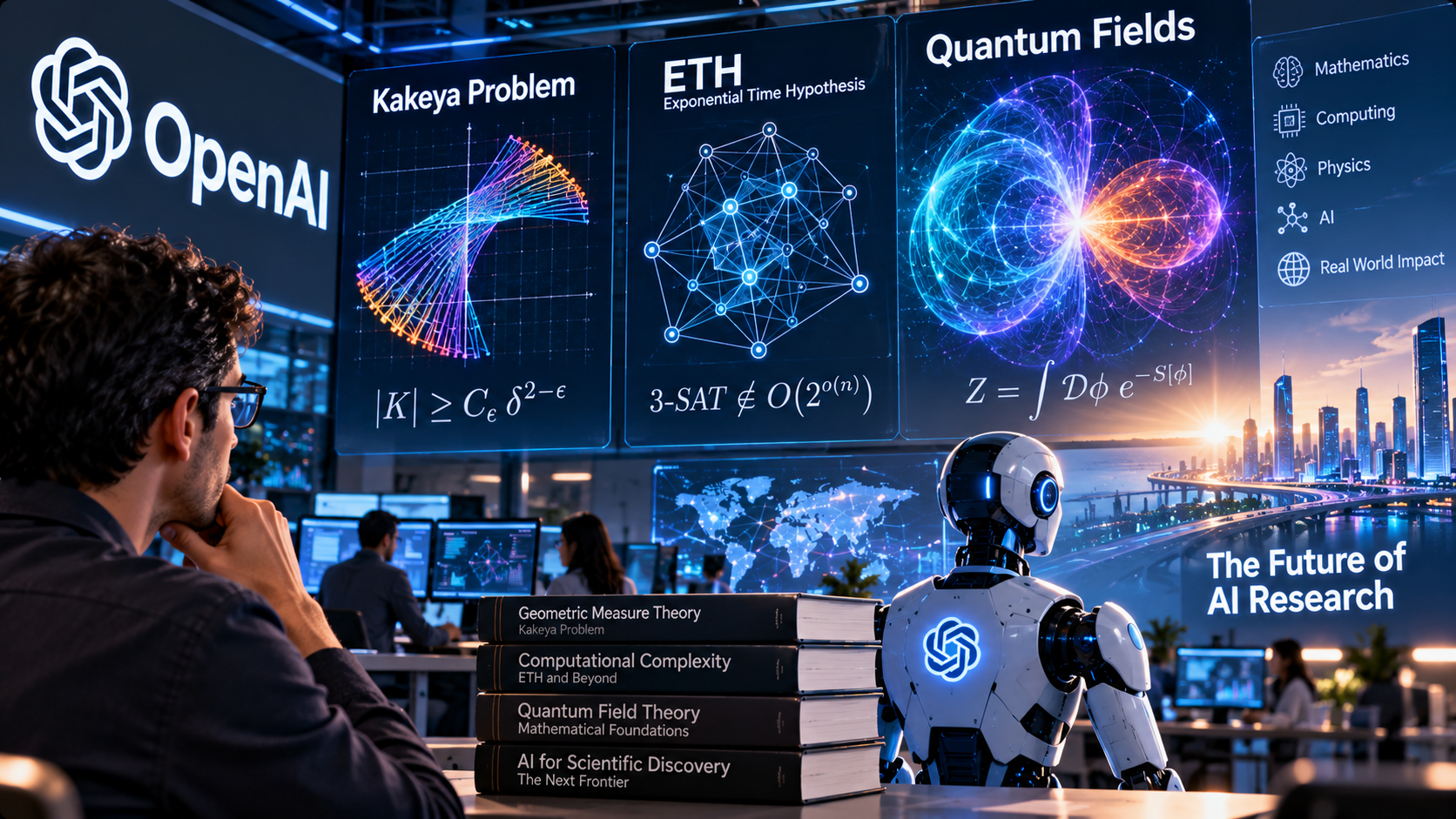
A published headline identifies three scientific claims associated with OpenAI and names the Kakeya problem, ETH and quantum fields as key topics. It also links the discussion to the future of AI research.
the underlying claims or explain what OpenAI is reported to have established is not yet available. It contains no research-paper titles, author names, technical results, dates of experiments or details about how the work was conducted.
What is currently known
The supplied information identifies the subject as a discussion of three scientific claims. The named areas are Kakeya, ETH and quantum fields. No further description is available for any of the three topics.
A separate related item refers to OpenAI working with academic communities to build scientific understanding. The supplied listing does not include details of that work, participating institutions or a connection to the three claims.
Other related listings use stronger descriptions, including references to the ETH hypothesis, the Kakeya conjecture and QCD. Those listings do not provide enough matching detail to establish the underlying results or confirm whether they describe the same scientific development.
Why the claims cannot yet be assessed
Assessing a mathematical or physics claim requires more than a headline. Readers would need the relevant paper or official announcement, the researchers involved, the precise result, and the evidence supporting it.
The available material provides none of those details. It therefore cannot establish whether any conjecture was extended, whether any hypothesis was overturned, or whether the work has practical consequences for artificial-intelligence research.
The dates attached to the related listings are 26 October 2026 and 27 October 2026. Those listings are presented as secondary leads and do not include enough information to verify their claims independently.
Conclusion
The available information points to a discussion of three OpenAI-related scientific claims involving Kakeya, ETH and quantum fields, but it does not contain sufficient evidence to explain or verify the results.
Frequently Asked Questions
Q. What scientific areas are named?
The available material names Kakeya, ETH and quantum fields.
Q. How many claims are identified?
The headline identifies three scientific claims.
Q. Are the claims explained in the available material?
No. The material does not provide the claims' technical details or supporting evidence.
Q. Does the material name the researchers?
No researchers are named in the available information.
Q. Does it establish an impact on AI research?
No. It links the discussion to the future of AI research but does not establish a specific impact.