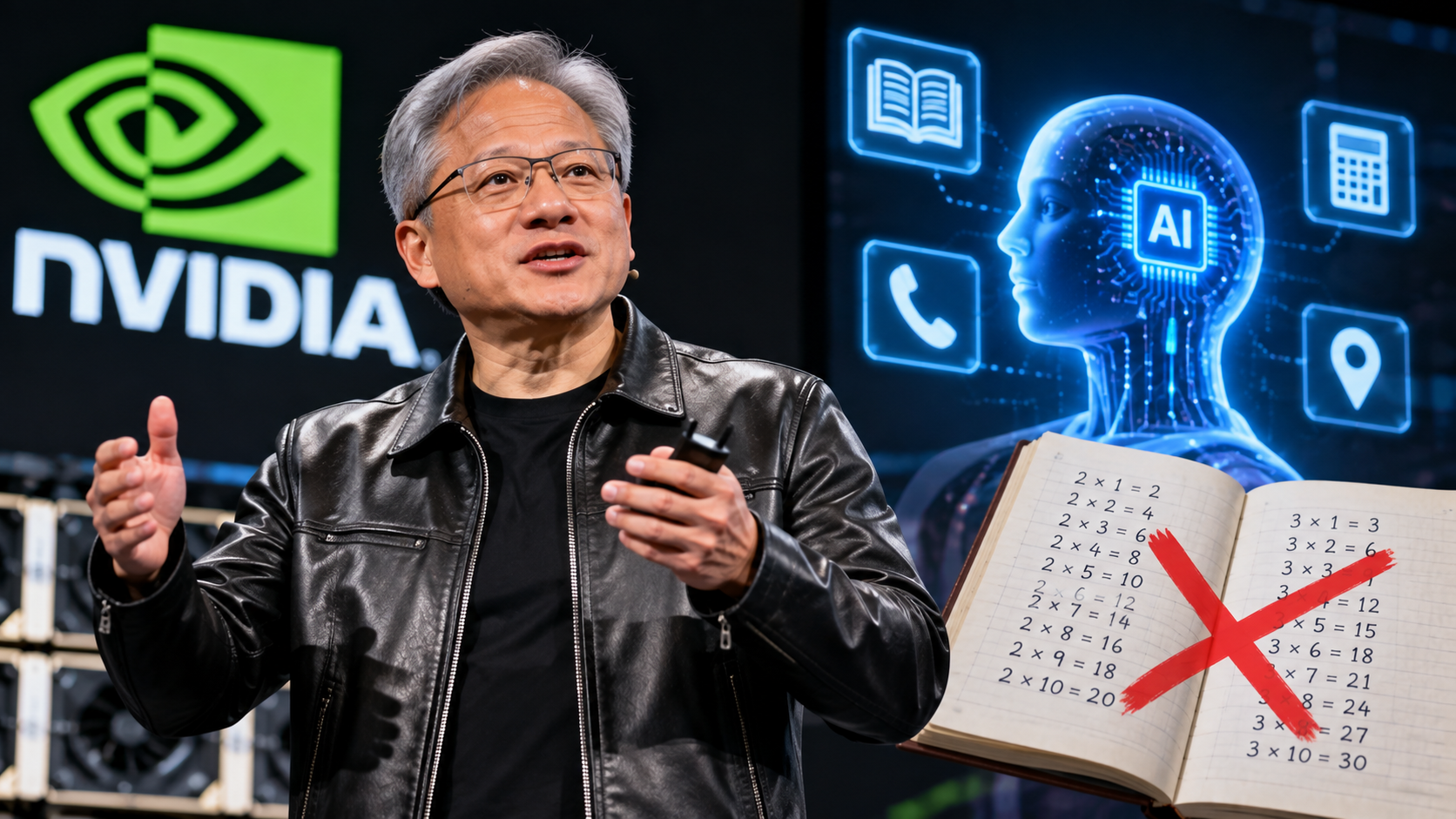
Nvidia CEO Jensen Huang has argued that artificial intelligence could change the way students learn basic mathematics, including whether they need to memorise multiplication tables. He also said he no longer remembers his home address or phone number, describing the decision to rely on technology for such information as one he is now comfortable with.
Huang made the comments during a conversation on the Ezra Klein Show about AI, memory and learning. He said the growing use of AI may weaken people's ability to think through some basic tasks. The discussion also referred to a Chinese study involving 26,000 students, which was presented in the conversation as evidence of declining cognitive skills among students.
Huang's view on basic maths
Huang said students today may struggle with tasks such as long division, finding square roots and recalling multiplication tables. However, he argued that memorising these procedures may no longer be essential in an AI-driven environment.
His position is that students could spend more time developing other skills while AI handles routine mathematical work. He described the loss of some basic abilities as a normal cost of technological progress, rather than as an exceptional problem.
Huang further argued that when AI takes over smaller, repetitive tasks, people can direct more intellectual effort towards complex problems. In his view, this could eventually produce stronger systems thinkers, even if some basic knowledge becomes less familiar.
Huang's personal example
Huang said he experienced the limits of relying on memory when he stopped at a petrol station and was asked for the ZIP code connected to his card during payment. He said he became anxious because he could not recall the code.
He added that he does not want to use his mental energy to retain details such as an address or phone number. His comments suggest that he sees external systems and AI tools as practical replacements for remembering some everyday information.
Experts challenge the argument
Experts cited in the report disagreed with the idea that people can give up basic understanding and automatically become better thinkers. Their view was that students who do not know multiplication tables or understand basic maths may find it harder to develop advanced thinking skills.
The report also presents a wider concern about young people's thinking ability and social skills. It says technology companies have warned about the risks of superintelligence, while critics believe the weakening of everyday cognitive abilities could itself become a serious issue.
The report also refers to Huang's claim about the arrival of artificial general intelligence after OpenAI introduced GPT-6 Astra. That claim is presented alongside the debate over how AI may affect children's mental development.
Conclusion
Huang's comments highlight a disagreement over what students should retain in an AI-led learning environment. He sees routine memory tasks as increasingly replaceable, while experts cited in the report argue that basic maths remains important for deeper thinking.
Frequently Asked Questions
Q. What did Jensen Huang say about multiplication tables?
Huang said students may no longer need to memorise multiplication tables because AI can handle routine mathematical tasks.
Q. Does Jensen Huang remember his phone number?
Huang said he does not remember his phone number or home address.
Q. Where did Huang discuss AI and maths skills?
He discussed the subject during a conversation on the Ezra Klein Show.
Q. What study was mentioned during the discussion?
The conversation referred to a Chinese study involving 26,000 students.
Q. What did experts say about basic maths?
Experts cited in the report rejected the idea that basic maths can be sacrificed without affecting advanced thinking.
Q. What example did Huang give about relying on technology?
He said he became anxious when he could not recall the ZIP code linked to his card during a petrol station payment.