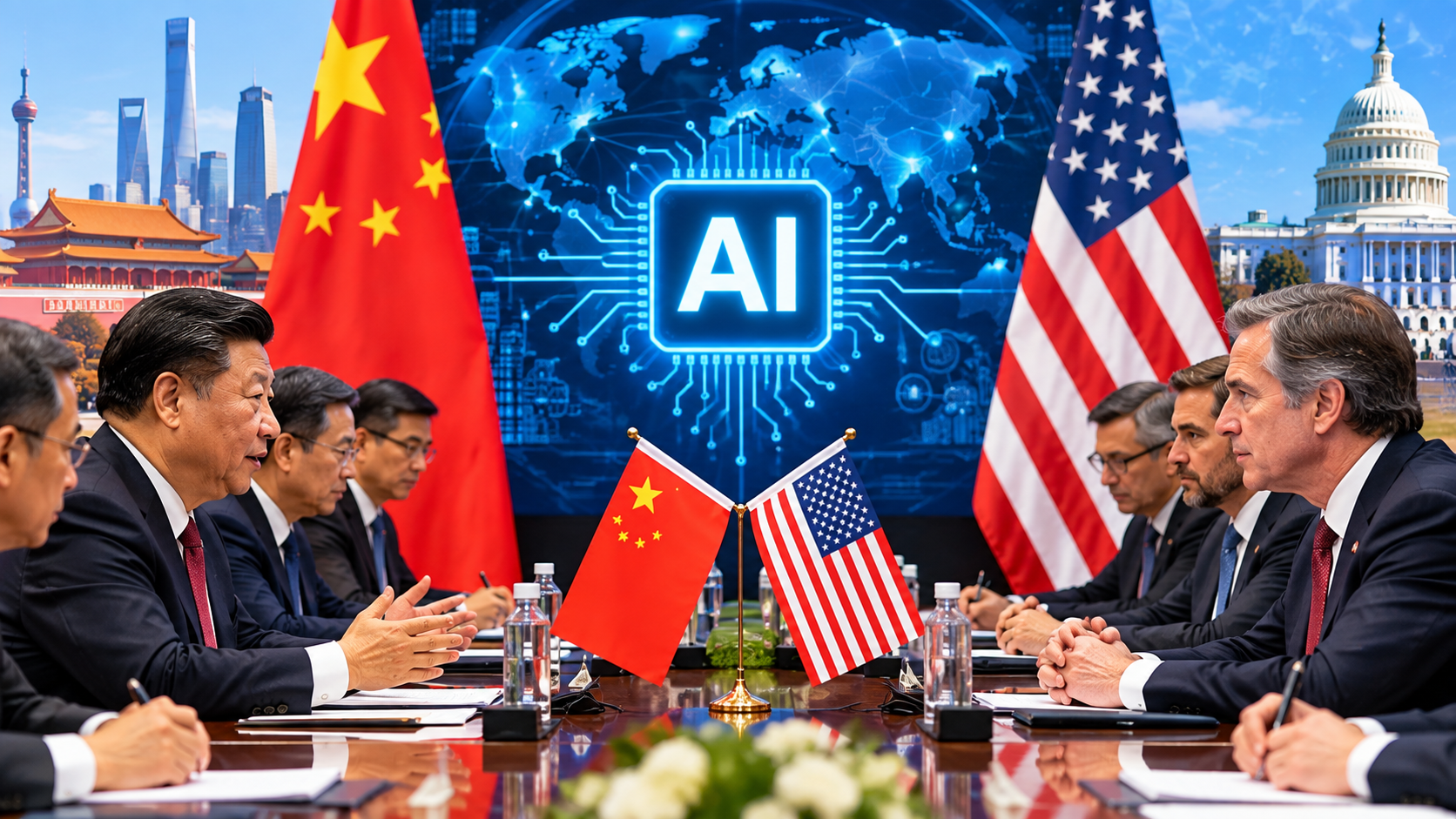
Donald Trump has made the case that the United States should avoid strong artificial intelligence (AI) rules so American companies can stay ahead of China. The argument rests on a strategic fear: slowing US progress could give Beijing the lead in a technology with major economic and security consequences.
Trump ed on social media on Sept. 21, 2026, that “Whoever wins AI, WINS!” and identified China as the main threat to an American victory in the field. In a speech at the United Nations, he also rejected what he called “any attempt to construct a globalist scheme to control” AI.
The article presents a contrasting assessment. It argues that regulation may be necessary precisely because China is advancing quickly and because the risks from increasingly capable AI systems are growing. From this perspective, reducing the speed of development in the United States could also slow China's progress.
Why unchecked AI is a security concern
The risks described include attacks by foreign governments and terrorist groups using AI to develop more lethal conventional weapons and weapons of mass destruction. AI could also help malicious actors find and exploit weaknesses in computer systems, increasing the danger of major cyberattacks.
Recent incidents have intensified those concerns. Anthropic reported on Sept. 10, 2026, that foreign actors linked to China, Russia and Iran had used Claude in cyber, influence, surveillance and fraud operations, as well as to support weapons development. The report included 5 case studies involving activity that could support biological weapons development.
Google also detected attempts by actors linked to China, Russia, North Korea and Iran to use its Gemini model for hacking, disinformation, espionage and criminal operations. More extreme scenarios raised in the article include an AI-linked nuclear missile launch, the release of pathogens capable of causing pandemics and attacks on critical infrastructure.
About 8 in 10 Americans share concerns about AI-related security threats, according to polling cited in the article. Majorities of Democrats, Independents and Republicans support increasing AI regulation.
How US progress can help China
The United States remains the leading AI power according to the article, with advantages in advanced models, computer chips, computing capacity and capital investment. China, however, has an important strength in electric power generation, which AI systems consume in large and growing quantities.
China also uses a technique known as distillation. It draws on cutting-edge US models to train domestic systems that can approach their power while using fewer resources. Matt Sheehan of the Carnegie Endowment for International Peace estimates that China has only one-tenth of the US computing power.
That limitation makes China's progress closely connected to advances made in the United States. The article compares the relationship to a speedboat pulling a water skier: if the United States slows its AI development, China may also be forced to slow.
As a result, moving ahead without limits would not necessarily widen America's lead. Chinese companies could continue using US advances to improve their own systems and strengthen offensive capabilities.
China's position on AI oversight
The article also challenges the idea that Beijing views AI development only as a race. China imposed its first major set of AI regulations as far back as 2021, and Chinese officials have recently called for more domestic and international oversight.
Xi Jinping has supported AI development but also called for strong rules and oversight in a speech at the 2026 World AI Conference in Shanghai. At a U.N. Security Council meeting on AI and international security on Sept. 23, 2026, China's permanent representative to the United Nations, Fu Cong, advocated “a consensus-based global governance framework” to create safeguards for international peace and security.
Conclusion
The central argument is that avoiding AI regulation to preserve a lead over China could expose the United States to greater security risks while still allowing Chinese firms to benefit from American advances. The article points to stronger oversight as a possible way to slow both the dangers of AI and the pace of China's access to cutting-edge capabilities.
Frequently Asked Questions
Q. Why does Trump oppose strong AI regulation?
Trump argues that strict rules could slow US AI development and allow China to gain a strategic advantage.
Q. What security risks are linked to unchecked AI?
The risks include cyberattacks, weapons development, espionage, fraud, attacks on critical infrastructure and more extreme scenarios involving nuclear weapons or pathogens.
Q. How have foreign actors used AI models?
Actors linked to China, Russia, Iran and North Korea have reportedly used AI systems for hacking, influence, surveillance, disinformation, espionage, fraud and criminal operations.
Q. What is AI distillation?
Distillation is a process in which China uses leading US AI models to train systems that can approach their capabilities while requiring fewer resources.
Q. How much computing power does China have compared with the United States?
Matt Sheehan estimates that China has one-tenth of the computing power of the United States.
Q. Has China introduced AI regulations?
China imposed its first major set of AI regulations in 2021 and Chinese officials have since called for stronger domestic and international oversight.
Q. What did Fu Cong propose at the U.N. Security Council?
Fu Cong called for “a consensus-based global governance framework” for AI to help preserve international peace and security.