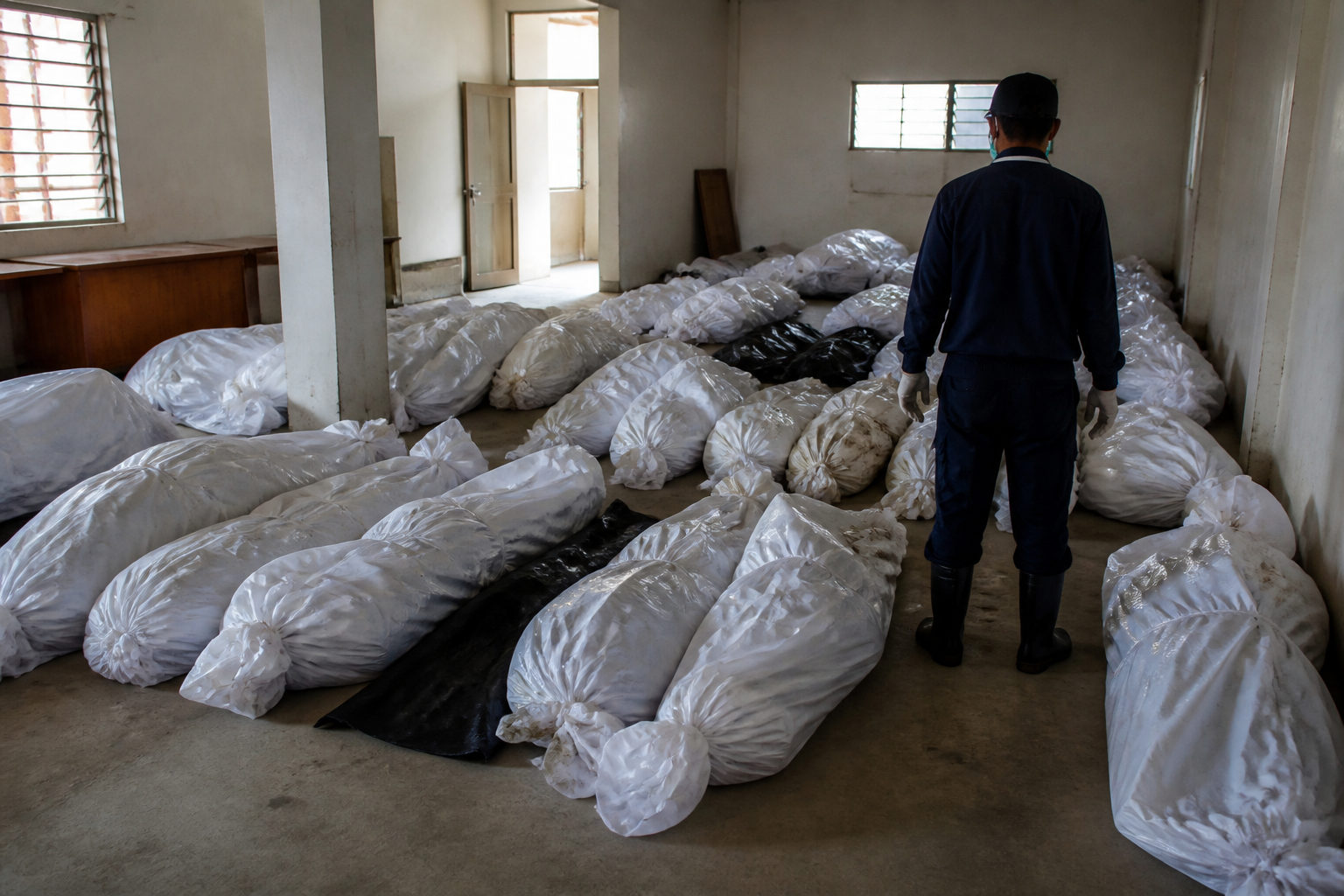
Nepal’s flood response is facing a growing challenge over the storage and management of bodies recovered during the search for missing people. Hospitals in Chitwan no longer have enough space, prompting officials to use a government office for temporary storage.
The situation has added to public-health concerns as rescue teams continue working across flood-affected areas. Officials say some bodies recovered on Thursday had already begun decomposing, making identification and safe management more difficult.
Chitwan reports 178 recovered bodies
Chitwan’s chief district officer, Ganesh Aryal, said 178 bodies had been found in the district. The figures given included 74 men, 41 women and 8 children, of whom 6 were boys and 2 were girls.
Aryal said the continuing search and rescue operation was making the handling of the remains increasingly difficult. He also said discussions were under way with the central government about the next steps.
Bodies being kept at a government office in Chitwan have begun to produce a strong smell, according to BBC correspondent Ishwar Joshi, who was in the area. He described the room as a place being used for identification and said the remains were in a state of decomposition.
579 bodies recovered in wider flood response
Nepal’s National Disaster Risk Reduction and Management Authority said 579 bodies had been recovered by Friday evening after flooding in the Bhotekoshi River. Authorities said about 4000 people had been rescued.
The authority’s latest update said the number of missing people in Nepal had risen into the thousands. Those missing include Nepali and foreign tourists, as well as employees of the police, army, armed police force, customs offices and immigration offices. The number of missing foreign nationals who had travelled to Nepal was given as 517.
Search operations remain active in several affected locations, including Rasuwa, Nuwakot, Dhading, Gorkha, Chitwan and Nawalparasi. Nepal’s Home Ministry said bodies were continuing to be found in those districts and that officials were coordinating how they should be managed.
Officials weigh local and central arrangements
Rama Acharya Subedi, deputy spokesperson for Nepal’s Home Ministry, said authorities were considering whether remains should be managed in the districts where they were found or transported to a central location. Officials are also discussing ways to speed up the process.
The Department of Epidemiology and Disease Control said the rising number of bodies in affected districts was creating an additional challenge for efforts to bring the health emergency under control.
Its director, Dr Anuj Bhattachan, said bodies needed to be kept in conditions with low humidity until their condition and identity could be established. He said that requirement was difficult to meet when large numbers of remains arrived at once and available capacity was limited.
Some bodies found in Dhading had to be sent to Kathmandu and Pokhara, according to Bhattachan. He added that several remains had been damaged, making prolonged storage in refrigerators difficult while identification efforts continued.
Authorities are therefore managing 2 linked tasks: continuing the search for people still missing and finding suitable arrangements for bodies already recovered. The Home Ministry and disaster-management officials are discussing the arrangements as recovery work proceeds.