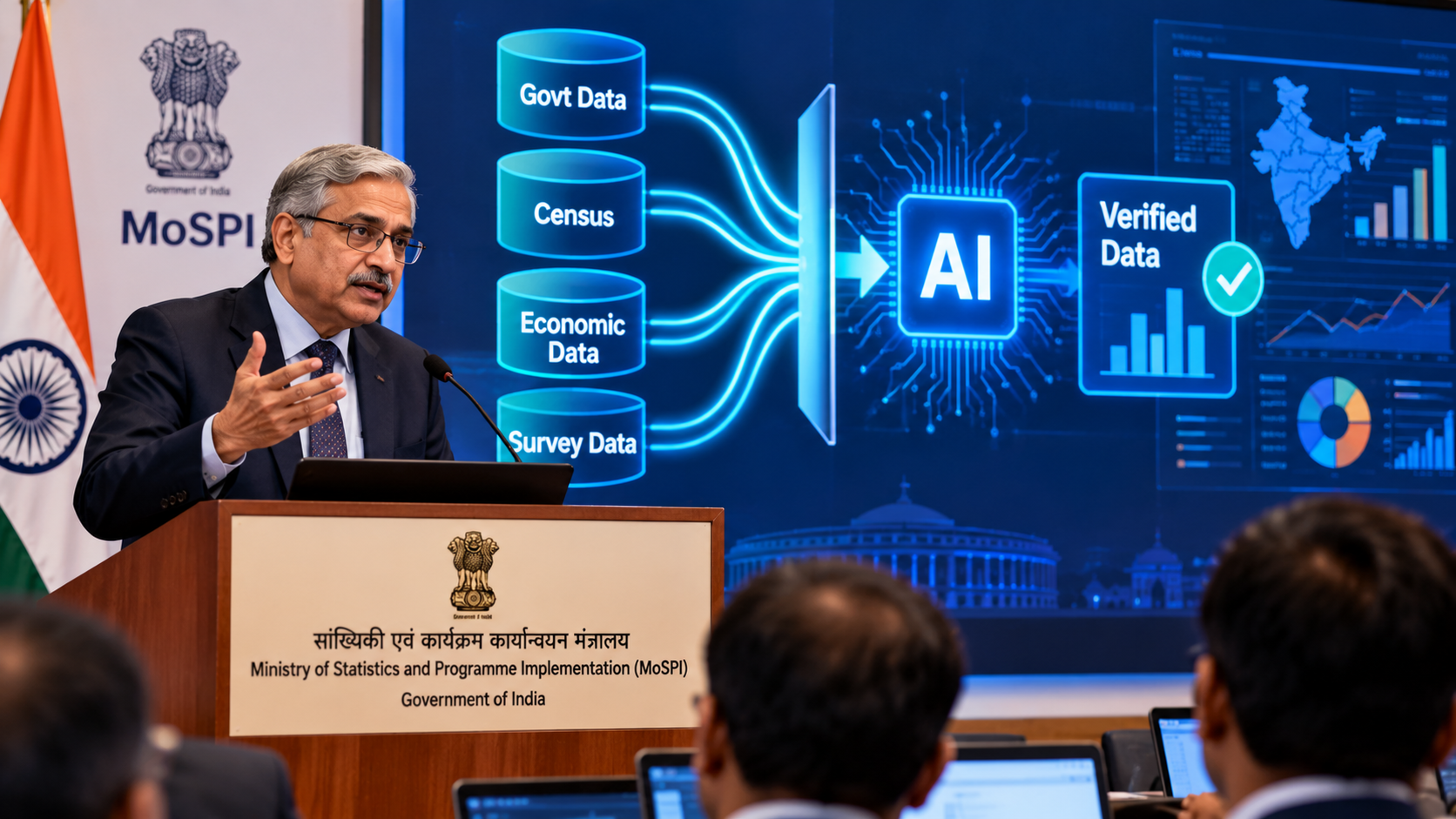
India's statistical system needs to become more agile, responsive to feedback and capable of sharing data across ministries and states, Ministry of Statistics and Programme Implementation (Mospi) Secretary Saurabh Garg said on Thursday.
Speaking at the Public Affairs Forum of India (PAFI) 13th Annual Forum in New Delhi, Garg said data harmonisation would be a central priority. He pointed to standardised definitions, embedded identifiers and machine-readable formats as the building blocks needed to combine datasets held by different government departments.
Building interoperable data
Garg said datasets should be able to work together rather than remain isolated within separate departments. He also said citizens and businesses should not have to provide the same information repeatedly to different parts of the government.
The approach involves making data interoperable, meaning that systems can exchange and use information in a consistent way. Garg linked this to the broader challenge of delivering digital services at scale while ensuring that they remain accessible to all.
He cited PM Gati Shakti and one Nation, one Ration Card as examples in which interoperable data has supported service delivery. The examples were presented as illustrations of how information sharing can help government programmes operate across administrative boundaries.
AI use tied to verified sources
Garg described artificial intelligence (AI) as an evolving area and said Mospi is using it for analytical work within defined limits. Any inference generated from data, he said, must be based on sources that have been verified and validated.
He also called for clear guardrails around small domain models to reduce the risk of hallucination. In survey operations, AI is helping enumerators classify occupations and industries during house-to-house exercises, a use he said is improving data quality.
The emphasis on verified inputs places data quality at the centre of the ministry's AI work. It also distinguishes analytical use of AI from relying on unsupported or unvalidated outputs.
Faster surveys and more local detail
Technology has changed how household surveys are conducted. Garg said the process has moved from pen and paper to tablets, with information uploaded to backend platforms in real time. The shift is intended to improve the timeliness of official data.
He also referred to data from the Public Financial Management System (PFMS) and Unified Payments Interface (UPI) payments. These sources are helping provide a clearer view of the sectors and regions recording expenditure growth and expansion.
Mospi has begun releasing district-level analysis in recent months. Garg said this would support local decision-making by showing conditions at a more detailed level than a single state-level or national picture.
Aligning state and central statistics
At the sub-national level, Mospi is working with State Directorates of Economics and Statistics (DE&S) to align information on labour, inflation and industrial growth with central protocols.
The ministry has issued guidelines for Gross State Domestic Product and is working with states to produce District Domestic Product estimates. Garg said these estimates would help states publish data that can be compared across states.
Mospi also tracks about 28 international indices. The ministry reviews their data sources and methodologies with the ministries concerned to assess whether they are appropriate for India.
Garg noted that some international indices have changed after feedback from several countries. He cited the World Bank's replacement of the Ease of Doing Business ranking with the B-READY Index as an example.
Conclusion
Garg's message combined a push for connected government data with caution over how AI is used in official analysis. Mospi's stated priorities include common data standards, faster collection, more district-level detail and comparable statistics across states.
Frequently Asked Questions
Q. What did Saurabh Garg say about government data?
He said data should flow more freely across ministries and states, supported by standard definitions, embedded identifiers and machine-readable formats.
Q. What are Mospi's safeguards for AI?
Garg said AI-generated data or inferences must be based on verified and validated sources. He also called for guardrails around small domain models to prevent hallucination.
Q. How is AI being used in household surveys?
AI is helping enumerators classify occupations and industries during house-to-house surveys.
Q. What is the purpose of district-level analysis?
Garg said district-level analysis can support local decision-making and avoid relying only on a single state-level or national picture.
Q. What economic estimates is Mospi developing with states?
Mospi is working with states to produce District Domestic Product estimates and has issued guidelines for Gross State Domestic Product.
Q. How are household surveys becoming faster?
Surveys have shifted from paper forms to tablets, with data uploaded to backend platforms in real time.