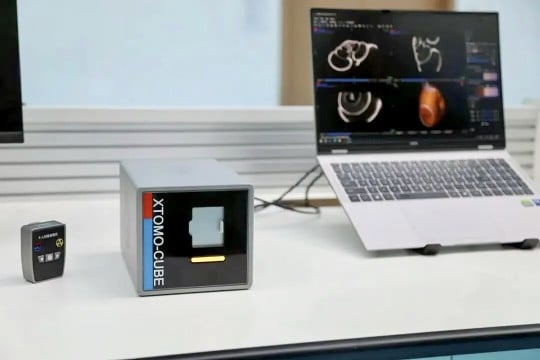
Chinese researchers have developed a compact computed tomography (CT) scanner designed to examine small fossils, archaeological relics and other objects outside conventional laboratory settings. The Xtomo-Cube weighs 6kg, is about the size of a desktop speaker and can be held in one hand.
The device was built by Shandong province-based Rayim. Liu Baodong, a senior engineer at the Chinese Academy of Sciences and Rayim’s general manager, described it as the world’s smallest and lightest CT system, giving it the nickname “palm-sized CT scanner”.
Its portability is central to the design. The scanner consumes about 200 watts, allowing it to be powered by an ordinary portable power bank during fieldwork. That could make internal imaging more practical at archaeological sites, fossil locations and other places where large scanning equipment is difficult to transport.
What the scanner can examine
The Xtomo-Cube has a spatial resolution of 80 micrometres, roughly the width of a human hair. Liu said it can analyse objects ranging from snail shells to medicine capsules, producing s of their internal structures without damaging them.
CT scanning uses X-rays captured from multiple angles. A computer combines those s into a detailed 3D model, allowing researchers to inspect an object’s interior while leaving it intact. The technology is already used to examine fossils, archaeological finds and industrial components, as well as to identify tumours, internal bleeding and other medical conditions.
Rayim said the scanner’s key components—including the X-ray source, rotating platform and detector—were developed and manufactured in China. The company also designed the system so that its core parts could fit into a 4-litre package while retaining fine imaging detail.
Smaller than the previous record holder
The previous record holder for the smallest CT machine was a German-developed device weighing 19kg. At 6kg, the Xtomo-Cube is substantially lighter, according to the Science and Technology Daily.
Most hospital CT systems remain much larger. A typical hospital scanner is roughly 2 metres tall and wide and weighs around 2 tonnes, while some industrial systems are even larger and can weigh several tonnes.
Liu compared the new machine with a compact car in the CT sector, stressing that it is not intended to scan everything. Its purpose is to look inside small objects, where a full-size medical or industrial scanner would be impractical.
Potential use in classrooms and laboratories
The scanner’s relatively low-energy X-rays could also support use in university classrooms and research laboratories. Unlike many commercial CT systems, its settings and raw imaging data are open to users, according to Liu.
That access would allow students and researchers to experiment with how CT s are collected, reconstructed and improved. The system could therefore serve both as a field instrument and as a platform for studying the mechanics of CT imaging.
How CT technology has evolved
The first clinical CT scanner was used on a patient in London in 1971 to reveal a brain tumour. Developed by British engineer Godfrey Hounsfield, that 3-metre-long machine could scan only a patient’s head and took about 5 minutes to produce a pair of 2-dimensional s.
CT scanners have since become routine in hospitals around the world. Their use has also expanded beyond medicine, including the examination of fossils, archaeological relics and industrial parts without physical damage.
The Xtomo-Cube represents a different direction: reducing the scale and power requirements of CT equipment so that it can be taken closer to the objects being studied. Its reported combination of 6kg weight, 200-watt consumption and 80-micrometre resolution is aimed at small-object imaging rather than whole-body or large industrial scanning.
Conclusion
The Xtomo-Cube brings CT imaging into a much smaller and more portable format, with potential uses in field archaeology, fossil research, education and laboratory work. Its defining limits are also clear: it is designed to inspect small objects, not replace large medical or industrial scanners.
Frequently Asked Questions
Q. What is the Xtomo-Cube?
The Xtomo-Cube is a portable CT scanner developed by Shandong province-based Rayim for imaging small objects such as fossils, archaeological relics, snail shells and medicine capsules.
Q. How much does the scanner weigh?
The scanner weighs 6kg.
Q. How much power does the Xtomo-Cube use?
It consumes about 200 watts and can be powered by an ordinary portable power bank during fieldwork.
Q. What is the scanner’s spatial resolution?
Its spatial resolution is 80 micrometres, roughly the width of a human hair.
Q. What makes the scanner portable?
The system is about the size of a desktop speaker, can be held in one hand and was designed to fit its key components into a 4-litre package.
Q. Can it scan large objects or people?
The scanner is designed to look inside small objects. The reported material does not describe it as a replacement for hospital or large industrial CT systems.
Q. What can CT scanning reveal?
CT uses X-rays taken from multiple angles to create a detailed 3D model of an object’s internal structure.
Q. Can students and researchers access the scanner’s data?
According to Liu, the system’s settings and raw imaging data are open to users, allowing experiments with collection, reconstruction and improvement.
Q. Where were the scanner’s components made?
Rayim said its key components, including the X-ray source, rotating platform and detector, were developed and manufactured in China.