The government’s new UPI framework does not introduce a payment charge for ordinary users sending money to other individuals. Person-to-person (P2P) payments will remain free, regardless of the transaction amount.
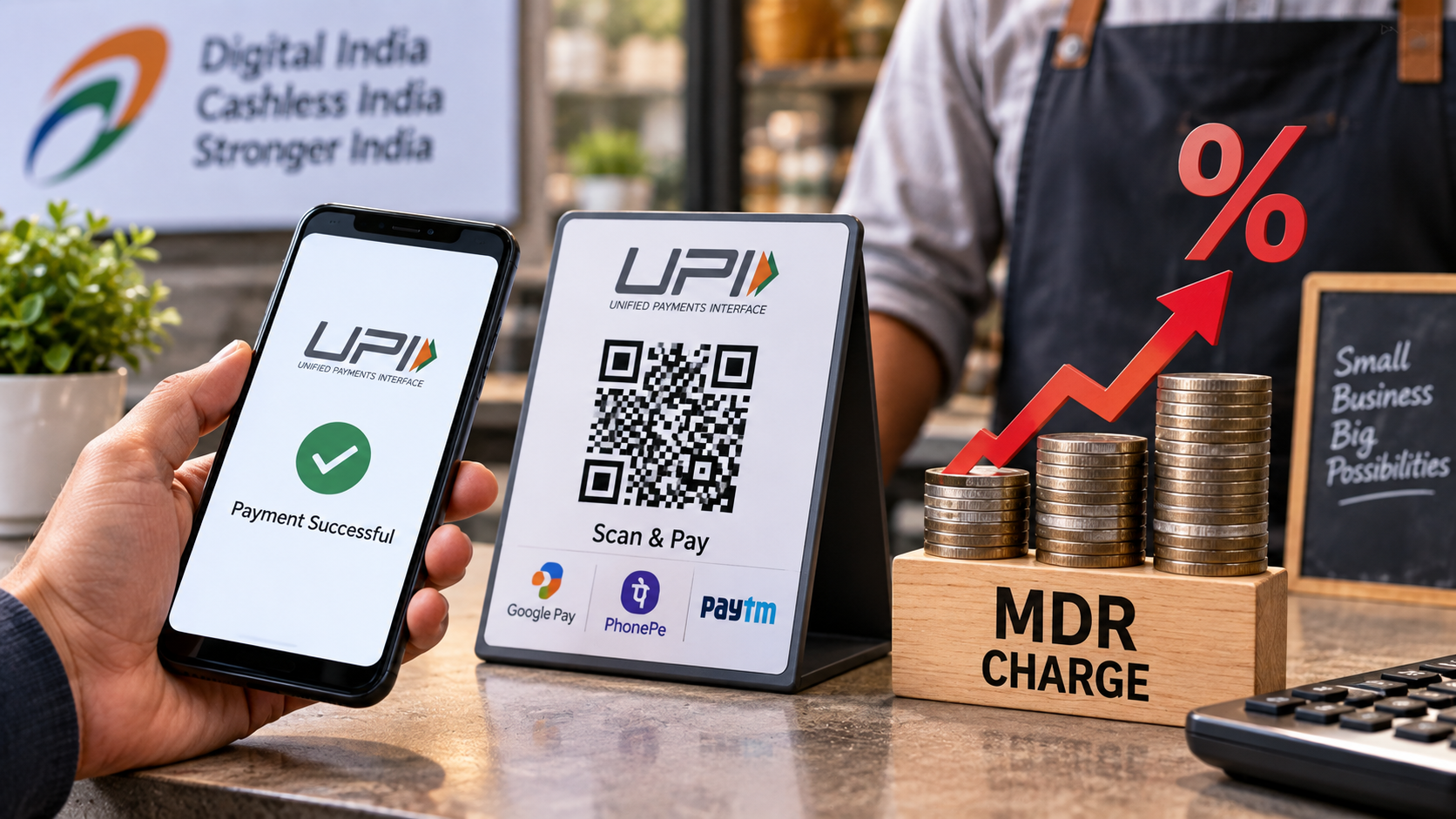
The main change concerns selected merchant transactions. While customers are not expected to pay a separate fee, some larger merchant payments may attract a merchant discount rate (MDR). The government has also directed banks to ensure that merchants do not pass this cost on to customers.
What remains free
A payment sent directly from one individual to another will not attract a charge. This covers transfers to family members, friends or other people through UPI.
According to the government, P2P payments make up about 70% of UPI’s total transaction value. This means the largest share of UPI payment value will continue under the existing free arrangement.
Merchant payments up to 2,000 rupees
Person-to-merchant (P2M) payments are transactions in which a customer pays a shop, service provider or another business. Examples include payments at grocery stores, petrol pumps and other shops.
MDR will not apply to P2M payments up to 2,000 rupees. The customer will not pay a fee, and the merchant will also not be charged MDR for payments within that limit.
What happens above 2,000 rupees
For ordinary merchant transactions above 2,000 rupees, the framework sets MDR at 0.4%. This is a charge connected with accepting a digital payment and is payable by the merchant rather than the customer.
The government has said customers must not be charged separately for using UPI. Banks have been asked to make sure merchants do not transfer the MDR cost to buyers through an additional payment fee.
For example, under the stated rate, a 10,000-rupee UPI payment would result in MDR of 40 rupees. That amount should be paid by the merchant, and the customer should not be asked to pay an additional 40 rupees for using UPI.
MDR cap and special services
The framework also sets a maximum amount for MDR. At a rate of 0.4%, the charge on a payment of 75,000 rupees would be 300 rupees. The maximum MDR remains 300 rupees even when the UPI payment is higher than 75,000 rupees.
Some essential services follow a separate arrangement. For transactions above 2,000 rupees in those services, the MDR will be a flat 5 rupees.
MDR is not a tax imposed by the government or the National Payments Corporation of India (NPCI). It is a fee within the merchant payment system, with the proceeds distributed among participating parts of the system, including banks, payment service providers and UPI app providers. The government says the money will support the operation and further development of UPI.
Who is affected
The framework leaves direct transfers between individuals unchanged. It also protects customers from a separate UPI fee and keeps merchant payments up to 2,000 rupees outside MDR.
The financial change is aimed at certain merchant payments above that threshold. Although the merchant bears the stated charge, the government’s instruction that it must not be passed to customers is central to how the framework is meant to work.
Conclusion
UPI remains free for P2P transfers, while merchant payments up to 2,000 rupees remain outside MDR. For eligible higher-value transactions, the stated merchant-side charge is capped, and customers should not be billed separately.
Frequently Asked Questions
Q. Will UPI payments between individuals remain free?
Yes. P2P UPI payments will remain free, regardless of the amount.
Q. Will customers pay MDR on merchant payments?
No. The stated MDR is payable by the merchant, and customers should not be charged separately for using UPI.
Q. Is MDR charged on merchant payments up to 2,000 rupees?
No. MDR will not apply to P2M payments up to 2,000 rupees.
Q. What is the MDR rate on ordinary merchant payments above 2,000 rupees?
The stated MDR is 0.4% for ordinary merchant transactions above 2,000 rupees.
Q. What is the maximum MDR on a UPI payment?
The maximum MDR is 300 rupees, including when the payment exceeds 75,000 rupees.
Q. Do essential services follow the same MDR rule?
No. Some essential services have a flat MDR of 5 rupees on transactions above 2,000 rupees.
Q. Is MDR a government or NPCI tax?
No. MDR is a fee within the merchant payment system, not a tax imposed by the government or NPCI.