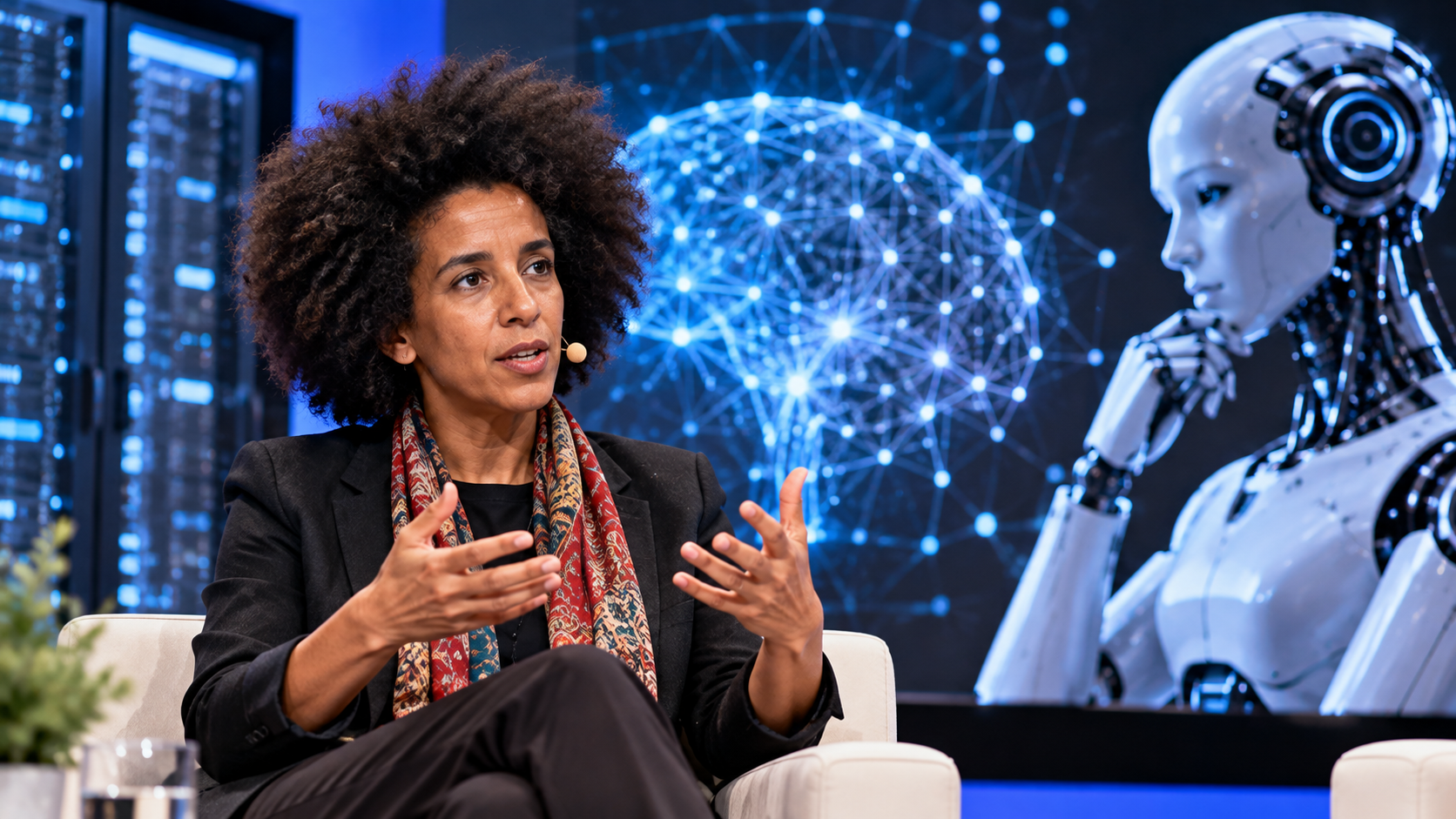
Timnit Gebru, one of the prominent critics of the artificial intelligence industry, has rejected claims that AI poses an existential threat to humanity, calling that narrative harmful because it draws attention away from immediate problems involving the technology.
In an interview with Lauren Goode, Gebru argued that the warnings are repeated by people and institutions with financial or strategic interests in the expansion of AI. She questioned why investors and founders who could benefit from companies becoming more valuable would also present those companies as capable of building systems that might destroy humanity.
Why Gebru challenges the existential-risk narrative
Gebru said the argument has circulated for years, citing statements by Elon Musk and Peter Thiel dating back to 2013. She also discussed the Future of Life Institute, founded by Max Tegmark and Jaan Tallinn, and METR, which she described as an auditor funded by Tallinn.
Her criticism focuses on the relationship between financial interests and public messaging. According to Gebru, the same industry voices that describe AI as powerful enough to create an existential danger also promote it as a tool that could help stop climate change, bring world peace and eradicate poverty.
She said this framing appeals to investors, governments and regulators. Presenting AI as unprecedentedly powerful, she argued, can make issues such as pollution from data centers, copyright disputes and data practices appear less important by comparison. It can also encourage governments to focus on hypothetical future systems rather than the conduct of companies today.
Gebru described this dynamic as regulatory capture. She pointed to public calls for international cooperation alongside lobbying and threats to withdraw when rules could impose meaningful obligations on AI companies. She also said that presenting companies as creators of “superintelligence” functions as marketing.
The rules Gebru says should be enforced
Gebru said existing laws could address several AI-related problems. Among the areas she highlighted were deceptive marketing, transparency and documentation of training data, and the treatment of data workers.
She argued that companies should explain where their data came from and document it before releasing systems. She also raised concerns about people who label data or perform work associated with chatbots while public discussion focuses on “superintelligence.”
In her view, stronger enforcement in these areas would slow companies down and make them accountable for how their systems are developed. She also said data should not be taken from people without permission.
Gebru contrasted these concerns with the way some technology leaders discuss existential risk at international forums. The interview refers to remarks by Sam Altman and Dario Amodei about global cooperation and possible risks to humanity. Gebru interpreted that public messaging as part of a strategy that can support industry influence over regulation.
What “stochastic parrots” means
Gebru also defended the research framework associated with her 2021 paper, “On the Dangers of Stochastic Parrots.” The phrase is a metaphor for large language models, which are trained on extensive collections of online text and generate likely sequences based on that training data.
She said the paper addressed the risks of building increasingly large language models, including environmental costs, a lack of data documentation and the possibility that users may mistake fluent output for evidence of a mind behind the system.
The interview discussed automation bias: the tendency to place too much trust in automated systems. Gebru gave examples of plausible language producing a wrong translation or misleading medical information. Her argument was that systems that do not understand the content they produce cannot be expected to be consistently factual.
She said the framework remains relevant because current chatbots still use large language models as a foundation. Gebru rejected the criticism that the research is outdated, arguing that the definition of large language models has not changed even as additional systems, including reinforcement-learning agents, have been added around them.
Dispute over reasoning and intelligence
The interview also examined criticism from Jack Clark, an Anthropic cofounder, who characterized “stochastic parrots” as a framework that caused people to underestimate what AI systems can do. Gebru said that criticism was not surprising and maintained that users are more likely to over-trust systems than to underestimate them.
She rejected claims that current AI systems possess reasoning or recursive intelligence. Gebru argued that names used in AI research can be aspirational and do not necessarily prove that the capability described by the name exists in the machine.
The conversation ended while discussing research on reasoning benchmarks and work associated with Samy Bengio, a former Google manager who later became head of machine learning research at Apple. The interview text ends before that discussion is completed.
Conclusion
Gebru's central argument is that public attention should focus on documented harms, transparency, labor, environmental costs and enforceable accountability rather than allowing speculative claims about humanity's extinction to dominate AI policy. She also maintains that the “stochastic parrots” framework remains relevant to understanding the limits and risks of large language models.
Frequently Asked Questions
Q. What does Timnit Gebru say about AI existential risk?
Gebru says the narrative that AI could destroy humanity is harmful because it distracts from immediate problems involving AI companies and their systems.
Q. What are stochastic parrots?
“Stochastic parrots” is a metaphor for large language models that generate likely sequences of text from their training data rather than understanding the text as a human does.
Q. What AI rules does Gebru support?
She highlights deceptive-marketing rules, data transparency and documentation, and protections concerning labor exploitation and data use.
Q. Why does Gebru criticize AI industry messaging?
She argues that founders, investors and institutions with commercial interests can benefit from portraying AI as exceptionally powerful and beyond existing regulation.
Q. What is automation bias?
Automation bias is the tendency to place excessive trust in an automated system, including when its fluent output is incorrect.
Q. What happened to Gebru at Google?
She left Google after a dispute connected to a research paper that examined bias and other risks associated with large language models.
Q. Does Gebru believe current AI systems have reasoning?
In the interview, she rejects claims that current AI systems possess reasoning or recursive intelligence, and questions whether aspirational research labels demonstrate those capabilities.