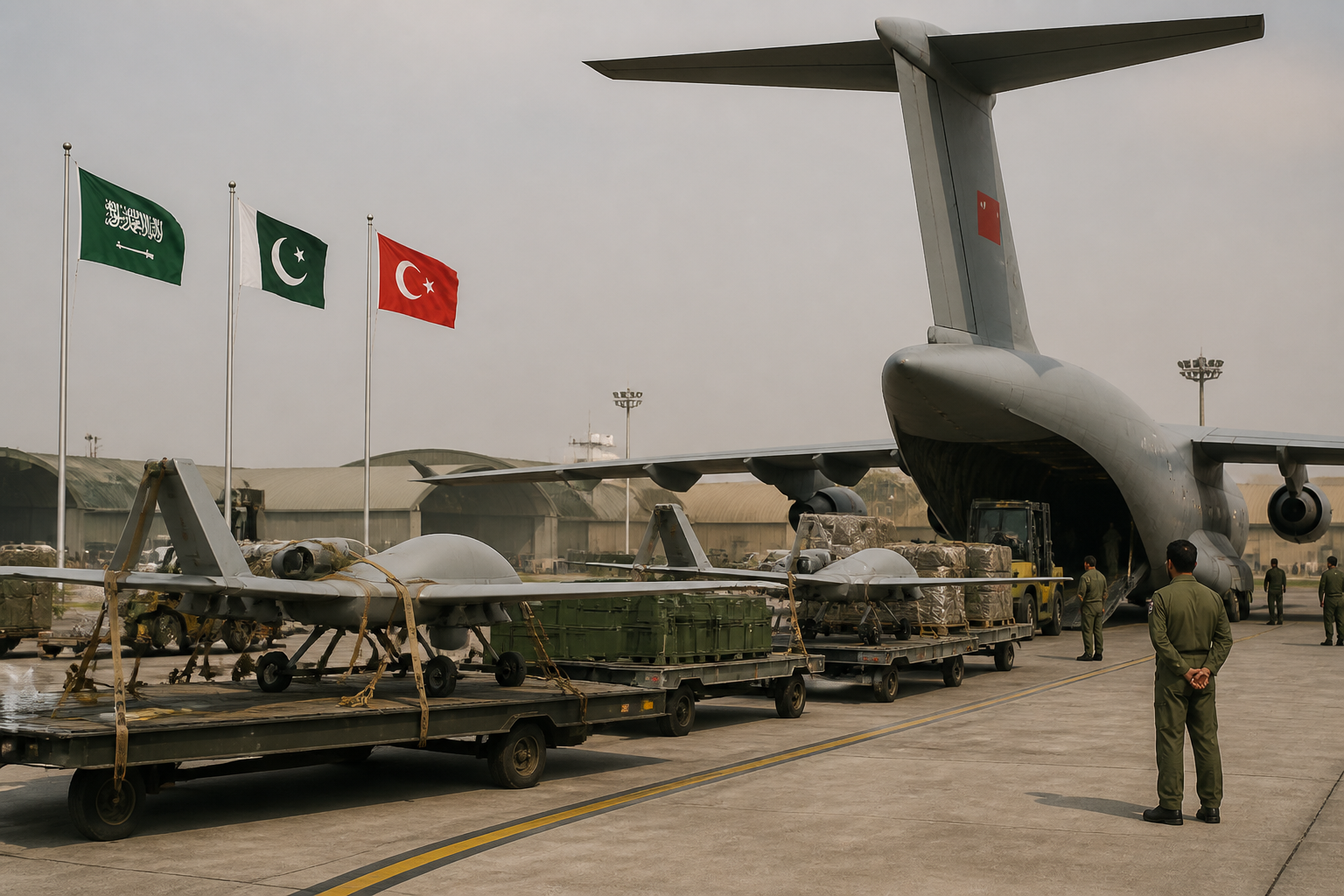
Dozens of Turkish military aircraft reportedly landed at and departed from Pakistani airbases during a period of about 60 hours between 19 and 21 August. The reported activity included C-130 transport aircraft and an A-400M military aircraft, and was linked to the delivery of drones and other defence equipment to Pakistan.
The reported movements came amid defence arrangements involving Pakistan, Saudi Arabia and Turkiye. The account also connects the alleged deliveries with Pakistan’s military requirements, preparations for an operation in Balochistan and the country’s rising defence expenditure.
Aircraft movements at Pakistani bases
According to the report, Turkish C-130 aircraft made repeated visits to the Nur Khan airbase in Rawalpindi and the Masroor airbase in Karachi. An A-400M aircraft reached Murid airbase and was identified by the call sign TUAF 526.
The reported aircraft activity continued across the three-day period. The account describes the C-130 as a military transport aircraft and the A-400M as a large military aircraft. It alleges that the aircraft were used to move a substantial consignment of drones to Pakistan.
The report further alleges that the drone deliveries took place during the night. It presents the timing as an effort to conceal the activity from satellite tracking. It says the equipment was subsequently kept at military storage facilities in Bahawalpur and Rawalpindi.
No separate details are provided in the supplied material about the total number of aircraft, the number of drones delivered or the individual consignments stored at either facility.
Drones, missiles and aircraft support
The defence equipment described in the report includes modern Turkish drones, missiles and other military hardware. The systems named are the AI-guided Kemankeş cruise missile, the Bayraktar TB2 drone and the Akıncı drone.
The account also says that Turkiye helped upgrade Pakistan’s F-16 fighter aircraft. It presents the alleged drone supply and aircraft support as part of broader military cooperation rather than as an isolated transfer.
The reported equipment includes different categories of capability:
- The Bayraktar TB2 and Akıncı are identified as drones.
- The Kemankeş is described as an AI-guided cruise missile.
- The C-130 and A-400M are identified as military transport aircraft involved in the reported airbase activity.
- Pakistan’s F-16 fleet is described as having received Turkish upgrade support.
The supplied account does not give a value for the equipment, a delivery contract number or a stated schedule for further shipments.
Defence agreement involving three countries
The report links the alleged deliveries to a joint defence agreement involving Pakistan, Saudi Arabia and Turkiye that was concluded in Mecca. It says Pakistan’s army chief, Asim Munir, asked Turkish President Recep Tayyip Erdoğan to provide drones during discussions connected with the agreement.
The account says Munir told Erdoğan that Pakistan’s air-defence system had suffered substantial damage during “Operation Sindoor”. It further claims that Pakistan had already received sufficient J-Series fighter aircraft from China, while a large part of its drone fleet had been lost during the operation.
The supplied material does not provide independent figures for the damage to Pakistan’s air-defence system, the number of aircraft received from China or the number of drones said to have been lost. Those details are presented as part of the report’s account of the request for additional Turkish drones.
Under the reported Mecca joint defence agreement, the three countries would support one another if any one of them were attacked. The arrangement is therefore described in the account as being viewed in some quarters as similar to NATO, although the supplied material does not identify a formal comparison document or provide the agreement’s full text.
Different roles for Saudi Arabia, Pakistan and Turkiye
The report cites TEPAV security analyst Dr Nihat Ali Özcan in describing the strategic roles of the three countries. Saudi Arabia is characterised as a leading crude-oil exporter and one of the world’s top-20 economies, giving it economic strength within the partnership.
Pakistan is described as the only Islamic country with nuclear weapons. The account also points to its ballistic missiles and large military force as elements of its role in the arrangement.
Turkiye is described as having the second-largest army among NATO countries after the United States. The report says it is contributing advanced military technology and experience, including cooperation with Pakistan and Saudi Arabia on drone technology.
The material does not specify the size of the forces involved, the exact technology shared or the terms governing that cooperation. It identifies the three countries’ economic, military and technological capabilities as the main components of the partnership.
Planned action in Balochistan
The report says Munir is preparing a major military operation in Balochistan against insurgents and that army units are being dispatched for the purpose. It adds that the action could begin within the next 48 hours.
The account also reports that three additional companies were deployed at Pakistan Army headquarters in Rawalpindi because of the possibility of attacks by Baloch insurgents. Pakistan’s government, led by Shehbaz Sharif, is said to have designated the Rawalpindi General Headquarters as a sensitive zone for the next six months on Saturday.
The supplied material does not name the units being sent to Balochistan or set out the planned area, objectives or operational structure of the reported action. The reference to a start within the next 48 hours is presented as a possibility rather than a confirmed launch date.
Claims about security control in the province
The report says Pakistan’s military position in Balochistan weakened after the launch of “Operation Shaban” in July. It claims that more than 25 military checkpoints have been vacated and that Balochistan Liberation Army, or BLA, fighters control several locations.
It also says Pakistani forces continue to face challenges in areas bordering Iran. Balochistan is identified as Pakistan’s largest province and as covering about 45% of the country’s territory.
The account attributes control of about 70% of the province to BLA and Pashtun insurgents. It describes the issue as extending beyond military action, saying that government control is also being tested in the operation of police stations, the security of highways and the ability of residents to travel between cities without fear.
According to the report, BLA and Pashtun groups have set up roadblocks in several areas. It says vehicles have been searched and money collected at some checkpoints, with a claim that the funds were directed to the BLA.
The report further says armed fighters have entered cities including Quetta, Khuzdar and Mastung and targeted police stations and government offices. The supplied material does not provide a separate count of attacks, identify specific incidents or give figures for casualties, arrests or displacement.
Military spending amid economic pressure
The account places the reported military activity against a backdrop of pressure from debt and inflation on Pakistan’s economy. It cites the International Monetary Fund as forecasting average inflation of 7.2% in 2026 and government debt at about 67.5% of gross domestic product.
Despite those pressures, the report says Pakistan’s military spending is increasing. Citing SIPRI, it puts the country’s military expenditure in 2025 at about $11.9 billion, an increase of 11% from 2024.
It also says Pakistan’s 2026–27 budget sets aside about 30.1 trillion Pakistani rupees for defence. The supplied material does not provide a breakdown of that allocation, identify the share assigned to drones or explain whether the reported Turkish equipment is included in the figure.
The figures cited in the account therefore cover separate issues: projected inflation and government debt for 2026, military spending for 2025 and the defence allocation in the 2026–27 budget. No calculation combining those figures is provided.
Journalist placed on terrorism monitoring list
The supplied report also describes government action against Danish Irshad, a journalist and researcher who covered protests in Pakistan-occupied Kashmir, or PoK. It says Pakistan placed his name on the Fourth Schedule, a terrorism-related monitoring list.
The account says the government did not disclose an allegation of terrorist activity against Irshad and that no court ruling against him had been presented. It further reports that his bank account was frozen and that restrictions were imposed on his travel.
The material does not state when the listing took effect, identify the legal order used or provide a response from Irshad or the Pakistani government. The action is presented in the report alongside its broader account of security measures and military developments in Pakistan.