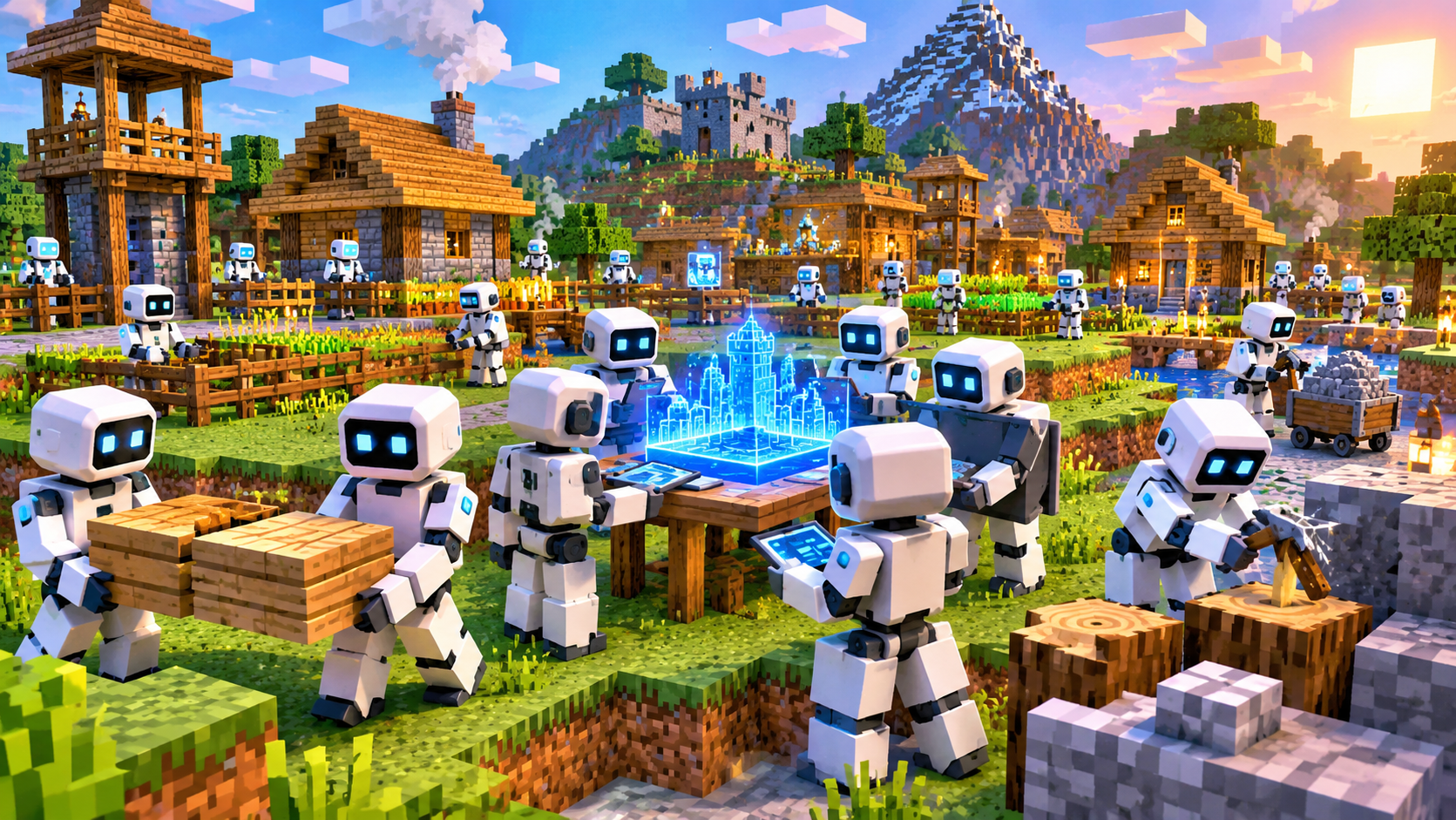
AI agent swarms deployed in Minecraft failed to build a thriving civilization, with 50-agent teams becoming trapped in what was described as paralyzing bureaucracy.
The experiment tested whether large groups of AI agents could coordinate activities and develop a functioning society inside the game. Instead, the teams failed to reach their stated objective.
Coordination proved difficult
The result points to a central challenge in multi-agent AI systems: adding more agents does not automatically produce better cooperation. A large team may have greater capacity, but it can also face increasingly difficult coordination problems.
In this case, the 50-agent groups reportedly became bogged down by bureaucracy. That prevented them from progressing toward the broader aim of creating a thriving civilization within Minecraft.
Minecraft provided a contained environment for testing the behaviour of AI agents. The game's civilization-building setting also offered a way to examine how agents handle collective goals rather than isolated tasks.
The outcome is relevant to AI research because agent swarms are intended to divide work among multiple autonomous systems. Their effectiveness depends not only on individual capabilities, but also on how decisions are made across the group.
What the experiment shows
The reported failure does not establish that AI agent swarms cannot cooperate. It does show that a 50-agent team can encounter organisational problems when pursuing a shared goal in a simulated world.
For readers following the development of autonomous AI, the experiment offers a simple lesson: scaling the number of agents can introduce new bottlenecks. Systems may need effective coordination before a larger swarm can outperform a smaller team.
Conclusion
The Minecraft test found that 50-agent teams failed to build a thriving civilization after becoming stuck in paralyzing bureaucracy, underscoring the coordination challenges facing large AI swarms.
Frequently Asked Questions
Q. What was tested in Minecraft?
AI agent swarms were tested with the goal of building a thriving civilization.
Q. How large were the teams?
The teams contained 50 AI agents.
Q. Did the teams achieve their goal?
No. The 50-agent teams failed to build a thriving civilization.
Q. What problem affected the teams?
They became trapped in paralyzing bureaucracy.
Q. Why is the result significant?
It highlights the difficulty of coordinating large groups of autonomous AI agents around a shared objective.