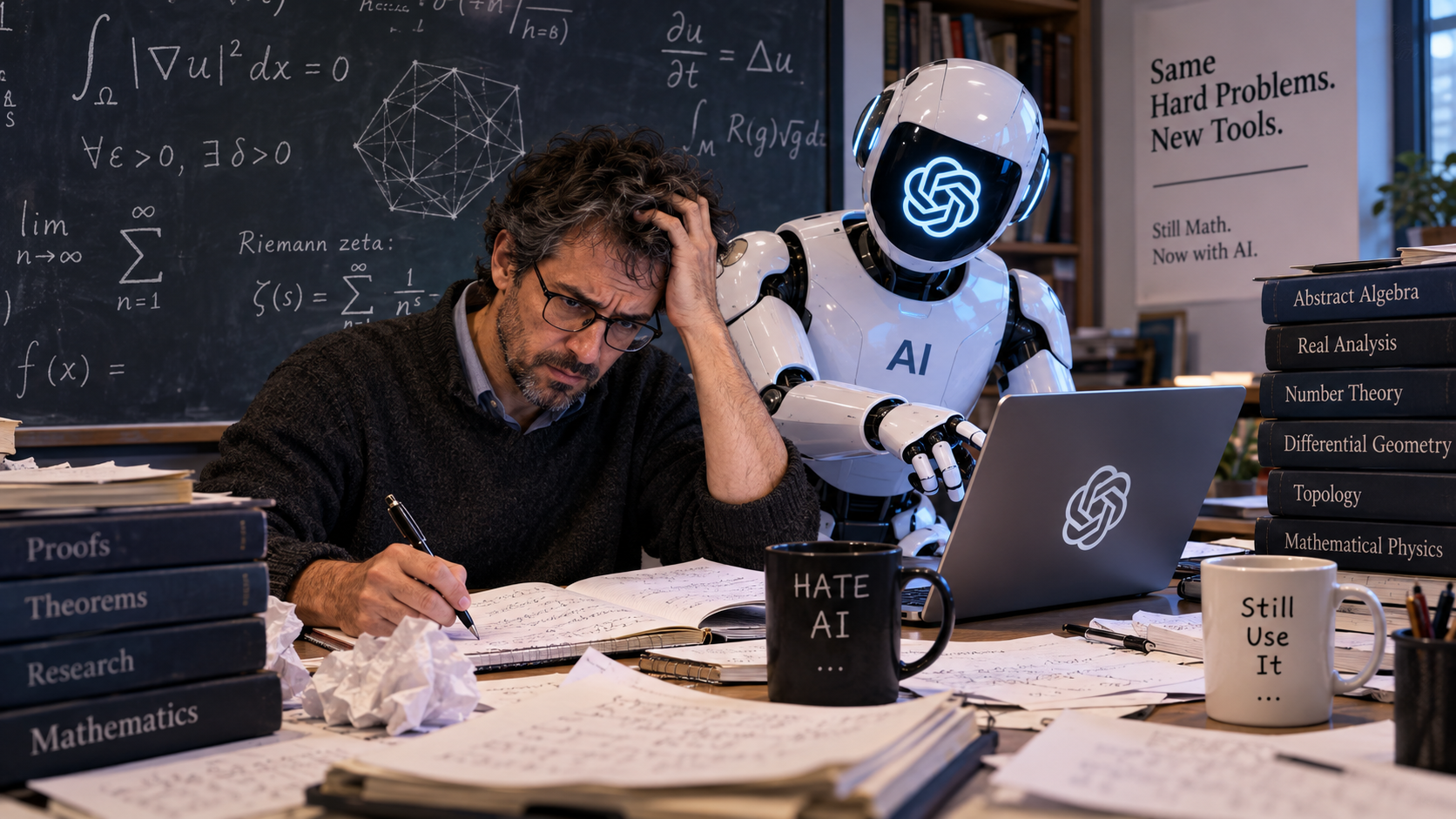
AI is becoming too useful for many mathematicians to ignore, even as researchers worry that it could disrupt how mathematical work is credited, checked and understood. The tension has sharpened after disputes involving OpenAI’s work on longstanding problems and questions about whether human research was properly acknowledged.
New York University professor Buckmaster has continued using OpenAI’s Codex coding agent after publicly accusing the company of copying his approach. He has used Codex to tidy research papers and to examine the logical steps that OpenAI’s agents may have taken in reaching a final proof. Buckmaster said the controversy has left him with little time for mathematics because it pushed him into the public spotlight.
He had used Codex, along with Anthropic’s Claude, while working with Anthropic researcher Levent Alpöge on the Navier-Stokes existence and smoothness problem. Buckmaster said OpenAI deployed tens of thousands of agents to reach a solution, but only after the company learned that the equation was close to being solved.
Disputes over credit and influence
Buckmaster’s public claims triggered a wider argument over whether advanced AI could make human mathematicians obsolete. OpenAI investigated the matter and amended its announcement about the Navier-Stokes result. The company said it had confirmed that Buckmaster’s Codex prompts during the 2 months before its announcement and paper on September 8, 2026, could not have influenced the system, including through training.
Buckmaster said the more important development was evidence that AI was pushing into areas at the frontier of mathematics. But he criticised the release of solutions to major problems without fully crediting the human work behind them, particularly before major IPOs. He called that approach irresponsible and “childish.”
A similar dispute involved German mathematician Andreas Thom. OpenAI said in August that its Astra model had used techniques from geometric group theory to prove a longstanding problem. Thom has spent 2 decades developing those techniques and said he was surprised that the system appeared to know about them.
Thom told OpenAI researchers Mark Sellke and Sébastien Bubeck that the company’s claim that there had been “no progress” on the problem during the last decade ignored his 2019 paper and work by other mathematicians. OpenAI amended its press release. Thom said he and a colleague had used ChatGPT while working on the problem, and that Sellke told him their interactions had not been included in training data.
Thom said he does not trust OpenAI’s statement that Buckmaster’s prompts could not have influenced the system. He also said he may never know whether his own work contributed to the result. In his view, AI has weakened the possibility of tracing who contributed what to a mathematical discovery.
A changing model of mathematical research
Traditional science depends on researchers building on one another’s work, subjecting findings to peer review and receiving credit for contributions. AI complicates that process because users may not understand every step an agent takes to produce an answer.
Cornell mathematician Alex Townsend said the situation raises a fundamental question about how a person can contribute to mathematics when trillion-dollar companies are participating in the field. Since August, he has seen colleagues asking what they need to learn about AI and how to obtain subscriptions to more powerful models.
Townsend said he feels both excited and nervous. AI can help him achieve things that would otherwise be out of reach, but its growing capabilities have also made him question his purpose as a mathematician.
Thom has continued to use ChatGPT to speed up the writing of papers, describing it as “extremely efficient.” He said he changed his privacy settings so that his work would not be used to train the data. OpenAI’s university and enterprise offerings default to not training models on users’ data.
The distinction between deliberate copying and information absorbed through an opaque technical process is important to Thom. He said he would be very angry if a person actively used his work without credit, but might be able to accept information being drawn into a model through a process that nobody fully understands.
Calls for safeguards
Some mathematicians have taken a harder line. Twenty-5 Fields medalists wrote in an open letter that AI companies and mathematicians are “severely misaligned.” More than 4,000 people have signed the Leiden Declaration, which sets out recommendations for mathematicians, funders and politicians on preventing AI from overwhelming the field.
Buckmaster is particularly concerned about ordinary uses of AI. He warned that a mathematician could ask a system to improve grammar and find that years of work were absorbed into user data and later sold to another mathematician or graduate student. He said many mathematicians see that as a real problem.
More than 2,000 people connected with Caltech called on organisers of an AI mathematics hackathon at the school to suspend the event. Anthropic and OpenAI sponsored the hackathon, although OpenAI later withdrew.
The effort to slow adoption may be difficult because of the efficiency AI provides. Thom said mathematicians who refuse to use the technology, particularly those early in their careers, could become isolated if others use it to accelerate their work. He and Buckmaster said the community needs to consider what AI means for younger researchers and how they can manage the transition.
Students are already asking what their future will look like as AI becomes more capable at solving mathematical problems, Townsend said. The question is no longer limited to research institutions; it is also shaping how the next generation views a career in mathematics.
Seeking rules without abandoning the technology
Buckmaster has called for a detente between AI developers and mathematicians while both sides establish rules for releasing results. He wants those rules to include accurate references and clearer recognition of earlier work.
He also plans to revise papers he published prematurely the previous week in an effort to get ahead of OpenAI’s announcement. Buckmaster described one of those papers as “AI slop” and said he has a responsibility to correct incomplete work and explain to mathematicians what his group did.
Despite the dispute, Buckmaster remains open to discussions with OpenAI. He said he does not want to keep engaging in fights, while adding that any future decision to work on a problem with the company would require caution.
Conclusion
Mathematicians are adopting AI because its efficiency is difficult to match, but the technology is forcing the field to confront unresolved questions about attribution, privacy, transparency and the role of human researchers. Calls for shared rules are growing as AI becomes more deeply embedded in mathematical work.
Frequently Asked Questions
Q. Why are mathematicians continuing to use AI?
AI can help with tasks such as writing papers, improving grammar and examining complex logical steps. Researchers say its efficiency makes it difficult to avoid completely.
Q. What is the dispute involving Buckmaster and OpenAI?
Buckmaster accused OpenAI of copying his approach during work connected to the Navier-Stokes existence and smoothness problem. OpenAI later said Buckmaster’s Codex prompts could not have influenced its system.
Q. Who is Andreas Thom?
Andreas Thom is a German mathematician who has spent 2 decades developing techniques in geometric group theory. He questioned OpenAI’s description of an Astra result involving those techniques.
Q. What is the Leiden Declaration?
The Leiden Declaration contains recommendations for mathematicians, funders and politicians on preventing AI from overwhelming the field. More than 4,000 people have signed it.
Q. How are mathematicians concerned about privacy?
Researchers fear that work entered into AI tools could become part of user data and later be used by others. Thom said he changed his ChatGPT privacy settings to stop his work being used for training.
Q. What happened at the Caltech AI mathematics hackathon?
More than 2,000 people connected with Caltech asked organisers to suspend the event. Anthropic and OpenAI sponsored it, although OpenAI later withdrew.
Q. Why is AI making attribution harder?
Mathematicians may not be able to trace which human ideas influenced an AI system or identify every step that produced a result. Thom said this threatens the traditional ability to determine who contributed what.
Q. What does Buckmaster want AI companies and mathematicians to do?
He is calling for ground rules covering the release of mathematical results, including accurate references and recognition of earlier work.