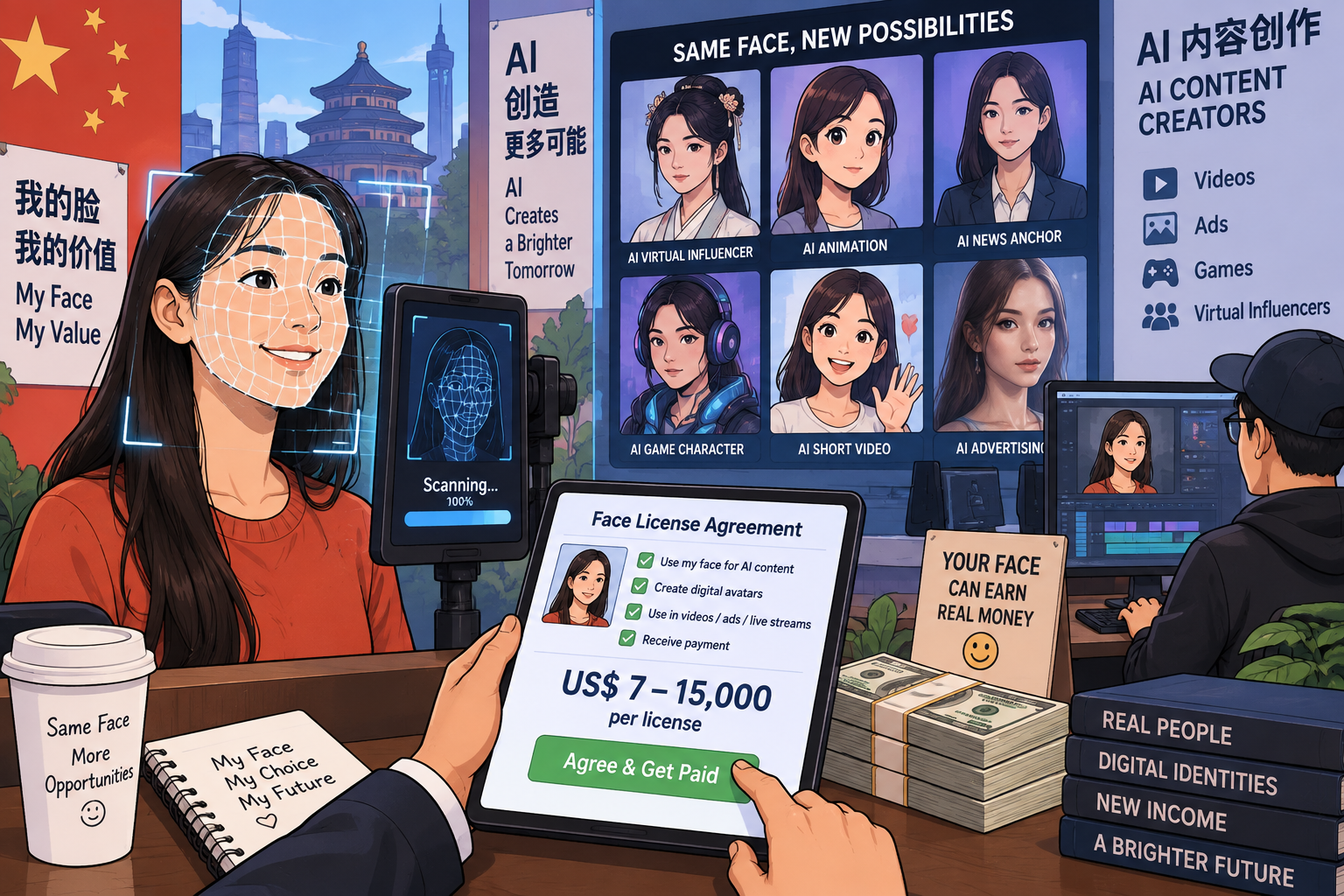
China’s growing face-licensing market is turning ordinary people’s likenesses into assets for AI-generated short dramas, advertisements and games. Digital platforms now connect users with content producers seeking permission to use their faces, with listed fees spanning from 50 yuan (US$7) to 99,999 yuan (US$15,000).
Private deals that previously circulated in film and television chat groups have increasingly moved onto public platforms since April. The shift is creating a formal marketplace for digital actors, while also raising questions about privacy, consent and how much control users retain after signing.
How the platforms work
Shenzhen-based Yuanxiang Xinsheng, launched in May, lets users register and complete identity verification before creating digital actor profiles. They can set conditions covering the length of use, forbidden content and secondary adaptation rights.
The platform states that permission to use a face does not automatically include the right to use it for AI training. That additional use must be agreed separately.
A man surnamed Chen, aged 34, lists a single-use fee of 99 yuan. His profile accepts romance and family productions but excludes horror and sexually explicit content. A woman from Guangdong province, identified as Kele, joined partly to protect her digital identity. She said people who want to use her face should pay for it.
Another platform, Xinzhua, launched in Chengdu in April and lists around 370 digital actor profiles. Its prices range from 500 yuan (US$75) to 6,000 yuan, with categories covering television commercials, modelling, films, animation and games.
Creators can search profiles by gender, age, style and genre. The platform also includes a category for children, although no minor profiles have been uploaded.
Payments and role restrictions
one bank employee reportedly received nearly 2,500 yuan (US$370) after an advertising company bought his portrait 7 times in 3 days, according to the National Business Daily.
Xinzhua’s most frequently used digital actor is a woman surnamed Lin. Each of 4 authorisation options on her profile costs 500 yuan. The permitted roles include villains, characters in revealing outfits, foreign identities and death scenes.
These listings allow creators to search for a face according to both appearance and intended role. For users, the arrangement offers payment and the ability to place conditions on how their likeness is presented.
Legal and consent concerns
Legal experts have focused on the handling of facial data, especially when children are involved. Children under 14 require parental consent for facial-data processing, while teenagers aged 16 and 17 may legally authorise such use but may not fully understand its consequences.
The Beijing News reported that some licensing agreements give operators stronger protection than users. Dai Yue, a lawyer at Hairun Tianrui Law Firm, said certain contracts require users to give up claims involving their portrait, voice, name and other personal rights.
Users may also face penalties of at least 50,000 yuan (US$7,500) if they withdraw permission early. By contrast, the platforms’ liabilities for delayed payments can be considerably lower, according to the report.
A divided market
The business has attracted both enthusiasm and scepticism on mainland social media. one reaction described the model as a way for ordinary people to pursue acting opportunities while earning money with little active involvement.
Another view questioned whether the market can grow: directors may value celebrity faces because audiences recognise them, while ordinary faces could instead be generated through AI.
Conclusion
China’s face-licensing platforms are creating a new route for people to earn from their likenesses, but the business is developing alongside unresolved concerns about consent, facial-data protection and unequal contract terms.
Frequently Asked Questions
Q. What is face licensing for AI content?
It is an arrangement in which a person authorises creators to use their likeness in AI-generated productions such as dramas, advertisements or games.
Q. How much can people charge for their faces?
Listed fees range from 50 yuan (US$7) to 99,999 yuan (US$15,000) on Yuanxiang Xinsheng. Xinzhua lists fees from 500 yuan (US$75) to 6,000 yuan.
Q. Does face authorisation include AI training rights?
Not automatically on Yuanxiang Xinsheng. AI training rights must be agreed separately.
Q. What restrictions can users set?
Users can specify the duration of use, prohibited content and secondary adaptation rights.
Q. What are the concerns about minors?
Children under 14 require parental consent for facial-data processing. Legal experts also question whether teenagers aged 16 and 17 fully understand the implications of authorising such use.