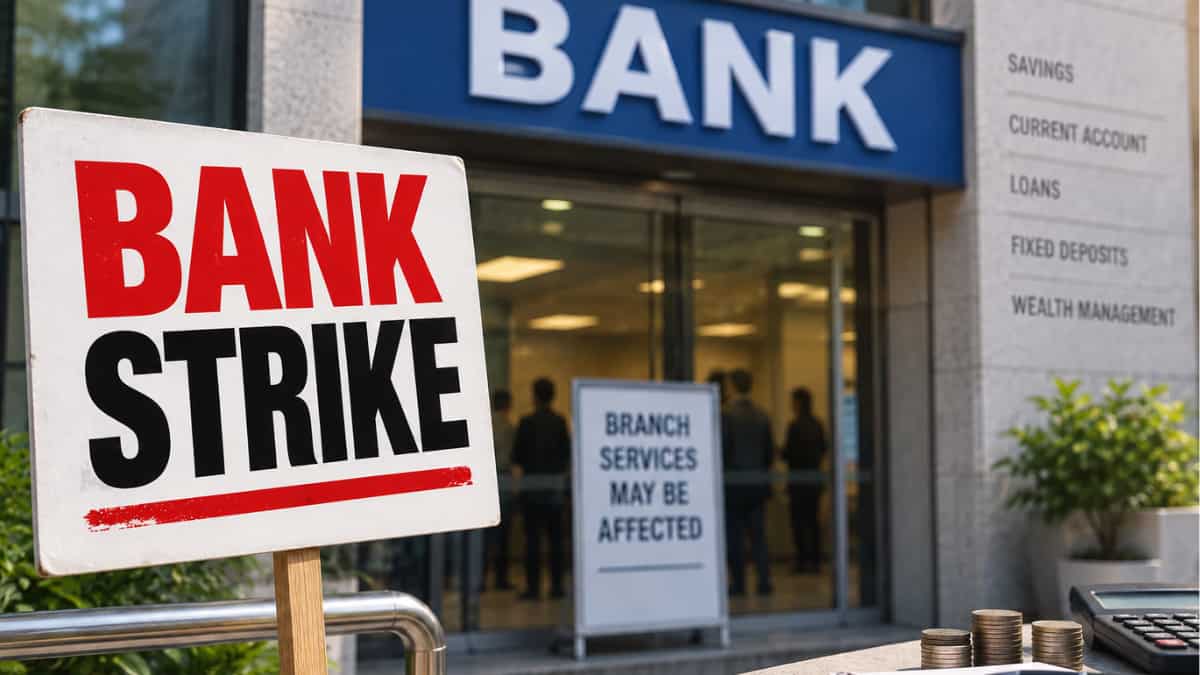
Bank unions are set to begin a 3-day strike from September 28, with bank branches expected to remain closed through September 30. The action includes a demand for a 5-day workweek, an issue that has now become the centre of a disagreement between employee representatives and the Finance Ministry.
A Finance Ministry source said the government never promised to introduce a Monday-to-Friday schedule for banks. The source also said the matter was not discussed during wage negotiations and that no agreement was reached on it.
The statement directly conflicts with the position of the unions. Rupam Roy, General Secretary of the All India Bank Officers' Confederation (AIBOC), has claimed that the demand was agreed with the Indian Banks' Association (IBA) under a bilateral wage revision agreement reached in March 2024.
What the Finance Ministry source said
According to the Finance Ministry source, the 5-day workweek was raised unilaterally by employee unions. The source said there was no consensus between the 2 sides and no commitment from the government on the proposal.
This position challenges the unions' understanding of the discussions that followed the wage settlement. The disagreement is over whether the proposal moved beyond a union demand and became an agreed part of the arrangement between bank employees and management.
What the unions claim
Roy's claim is that the IBA and bank unions reached an understanding on 5-day banking during the bilateral wage revision process. Under the proposal described in the report, employees would receive every Saturday as a holiday in exchange for working an additional 40 minutes from Monday to Friday each day.
The bank management, represented by the IBA, is reported to have accepted the proposal. However, the matter did not receive agreement when the file was sent to the Finance Ministry, leaving the issue unresolved.
What was included in the wage settlement
The wage settlement was signed on March 8, 2024. Bank employees' salaries and service conditions are negotiated through an agreement every 5 years.
The 2024 settlement covered several matters, including a 17% salary increase, the merger of DA with salary and special medical leave. The 5-day banking proposal is now disputed because the unions and the Finance Ministry source give different accounts of whether it formed part of the understanding.
For customers, the immediate practical development is the 3-day strike scheduled from September 28 to September 30. The wider question—whether banks will eventually move to a 5-day workweek—remains unsettled in the positions described by the 2 sides.
Conclusion
The strike will close banks for 3 days, while the proposed 5-day workweek remains disputed. Bank unions say the arrangement was agreed with the IBA, but a Finance Ministry source says there was no government promise, discussion or agreement on the issue.
Frequently Asked Questions
Q. When will the bank strike take place?
The strike is scheduled from September 28 to September 30.
Q. Why are bank unions calling the strike?
The unions are seeking a 5-day workweek along with other demands.
Q. What does the Finance Ministry say about 5-day banking?
A Finance Ministry source says the government never promised the change and that it was not discussed or agreed during wage negotiations.
Q. Who has claimed that 5-day banking was agreed?
Rupam Roy, General Secretary of AIBOC, has made that claim.
Q. When was the bank wage settlement signed?
The settlement was signed on March 8, 2024.
Q. What were some provisions of the settlement?
It included a 17% salary increase, DA merger with salary and special medical leave.
Q. What work arrangement did the union proposal include?
It involved every Saturday as a holiday and an additional 40 minutes of work from Monday to Friday each day.