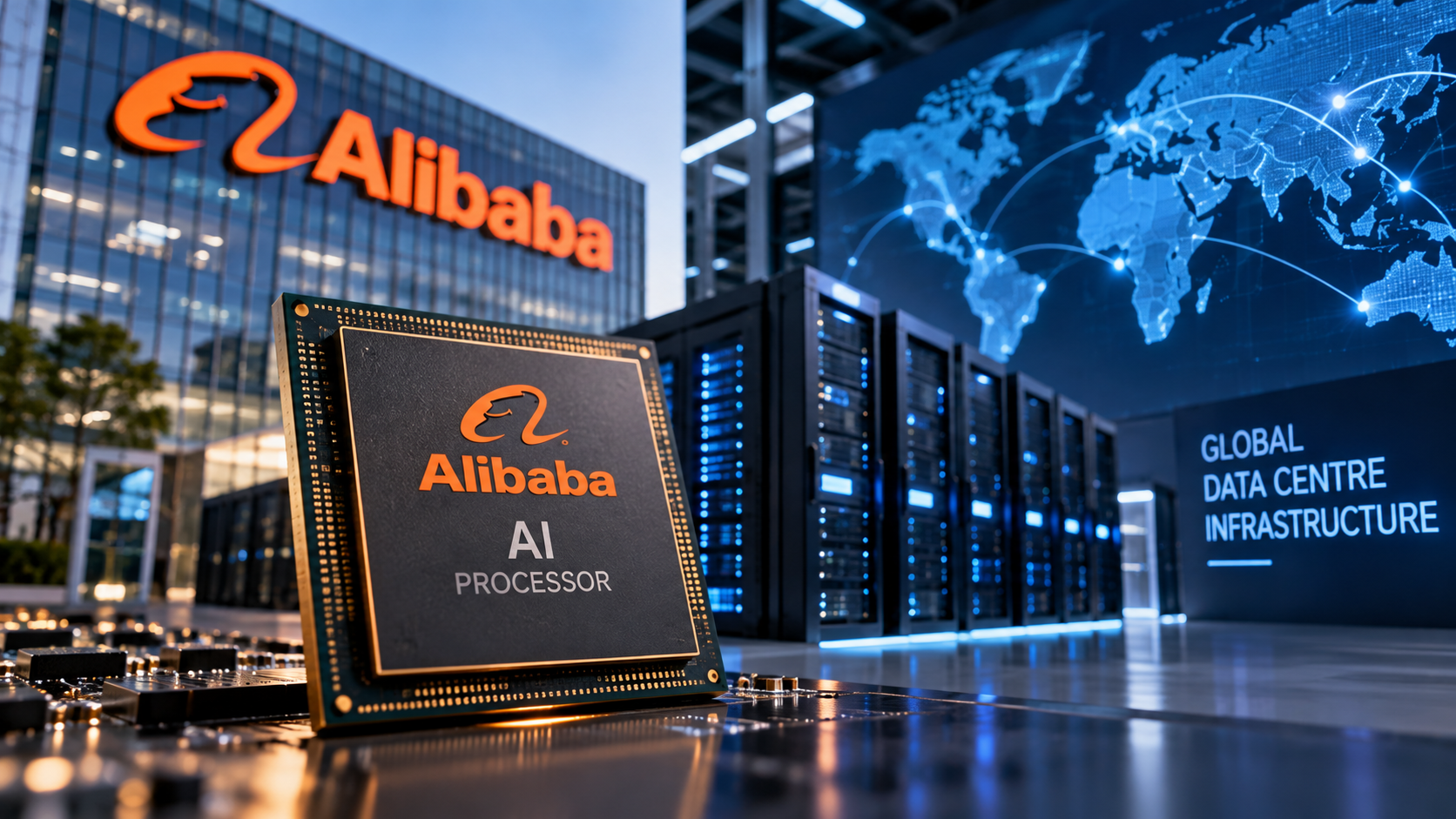
Alibaba Group Holding Ltd. has introduced a new AI accelerator as it steps up its effort to compete with Nvidia Corp. and expand the computing infrastructure needed for advanced artificial intelligence. The company named the chip Zhenwu V900 and said it delivers 3 times the performance of its predecessor.
The launch was outlined on Tuesday by Chief Executive Officer Eddie Wu. Developed by Alibaba’s T-Head division, the accelerator is designed to operate in large clusters, with as many as 500,000 units able to work together for frontier-model training, according to Wu.
A larger cloud infrastructure plan
Alibaba Cloud is targeting 20 gigawatts of data centre capacity worldwide by 2032. Wu linked the goal to what he described as exponentially rising demand for AI computing.
The planned capacity would support Alibaba’s wider shift from an ecommerce company into a major AI and cloud infrastructure operator. The company has pledged more than $53 billion over 3 years to expand its AI capabilities and raised about $10.2 billion through a follow-on share offering in Hong Kong in August.
Alibaba also plans to intensify spending on AI hardware and infrastructure. Its strategy includes updating the chip lineup every year and designing processors that can be combined in large clusters, an approach also used by Chinese chipmakers including Huawei Technologies Co. and Moore Threads Technology Co.
T-Head has delivered 560,000 units across the Zhenwu product family, Alibaba has said. The processors have been deployed by more than 400 external customers.
Bigger models and a possible T-Head listing
Alibaba is working toward an AI model with between 5 trillion and 10 trillion parameters. That would be substantially larger than the models commonly available from open-weight peers today and is intended to handle longer and more complex tasks.
The company also plans to list T-Head, seeking to benefit from strong interest in the AI accelerator market. Alibaba has expanded its Qwen model series while keeping prices low to attract users. It previously created the world’s most downloaded AI model, according to the company’s account of its AI business.
Executives have said annualised revenue from AI-related products is expected to reach $10 billion in the current quarter. Wu’s team has also said Alibaba should recover its overall AI investment within 3 years and aims to increase annual cloud and AI revenue to $100 billion in 5 years.
Spending, markets and US-China tensions
Alibaba’s AI expansion comes with significant financial pressure. Quarterly profit fell by more than 75% in the last quarter after the company undertook a spending programme of nearly $10 billion.
The announcement arrived as global AI stocks gained on early signs of progress for Meta Platforms Inc.’s new personal agent. Alibaba shares rose more than 5% in Hong Kong, while Tencent Holdings Ltd. gained more than 7%.
Alibaba’s 20-gigawatt target is large for a Chinese company but smaller than some other planned projects. SoftBank Group Corp., for example, has envisioned a 10-gigawatt-scale computing centre in Ohio alone.
The chip announcement also comes before a planned summit involving US President Donald Trump and Chinese President Xi Jinping. AI is expected to be among the issues discussed, with Nvidia Chief Executive Officer Jensen Huang and Microsoft Corp. Chief Executive Officer Satya Nadella due to attend a White House state dinner.
Talks between US Treasury Secretary Scott Bessent and Chinese Vice Premier He Lifeng began this week. The 2 sides agreed to establish an AI dialogue focused on reaching a shared understanding of goals and threats.
Washington has accused Alibaba and other Chinese developers, including DeepSeek, of illicitly accessing advanced American models to help build their own products. Beijing has rejected the accusations as groundless and said it would retaliate if Washington targets Chinese AI companies.
Conclusion
Alibaba’s Zhenwu V900 launch combines a new chip, a 20-gigawatt cloud capacity target and plans for much larger AI models. The company’s next phase will depend on expanding infrastructure, converting AI investment into revenue and navigating continuing US-China technology tensions.
Frequently Asked Questions
Q. What is Alibaba’s new Zhenwu V900 chip?
It is an AI accelerator developed by Alibaba’s T-Head division. Alibaba says it delivers 3 times the performance of its predecessor.
Q. How many Zhenwu chips can be used in one cluster?
The V900 can be combined in clusters of up to 500,000 units for frontier-model training.
Q. What is Alibaba Cloud’s data centre target?
Alibaba Cloud aims to reach 20 gigawatts of global data centre capacity by 2032.
Q. How much is Alibaba investing in AI?
Alibaba has committed more than $53 billion over 3 years to expand its AI capabilities.
Q. How large could Alibaba’s planned AI model be?
The company plans to develop a model with between 5 trillion and 10 trillion parameters.
Q. What is Alibaba’s plan for T-Head?
Alibaba plans to list T-Head to tap interest in the AI accelerator market.
Q. How many T-Head processors have been delivered?
Alibaba has said that T-Head has delivered 560,000 units from the Zhenwu product family.
Q. How many external customers use the processors?
The processors have been deployed by more than 400 external customers.
Q. What happened to Alibaba’s shares after the announcement?
Alibaba shares rose more than 5% in Hong Kong, while Tencent shares gained more than 7%.
Q. What AI-related talks are taking place between the US and China?
US and Chinese officials agreed to establish an AI dialogue focused on goals and threats.