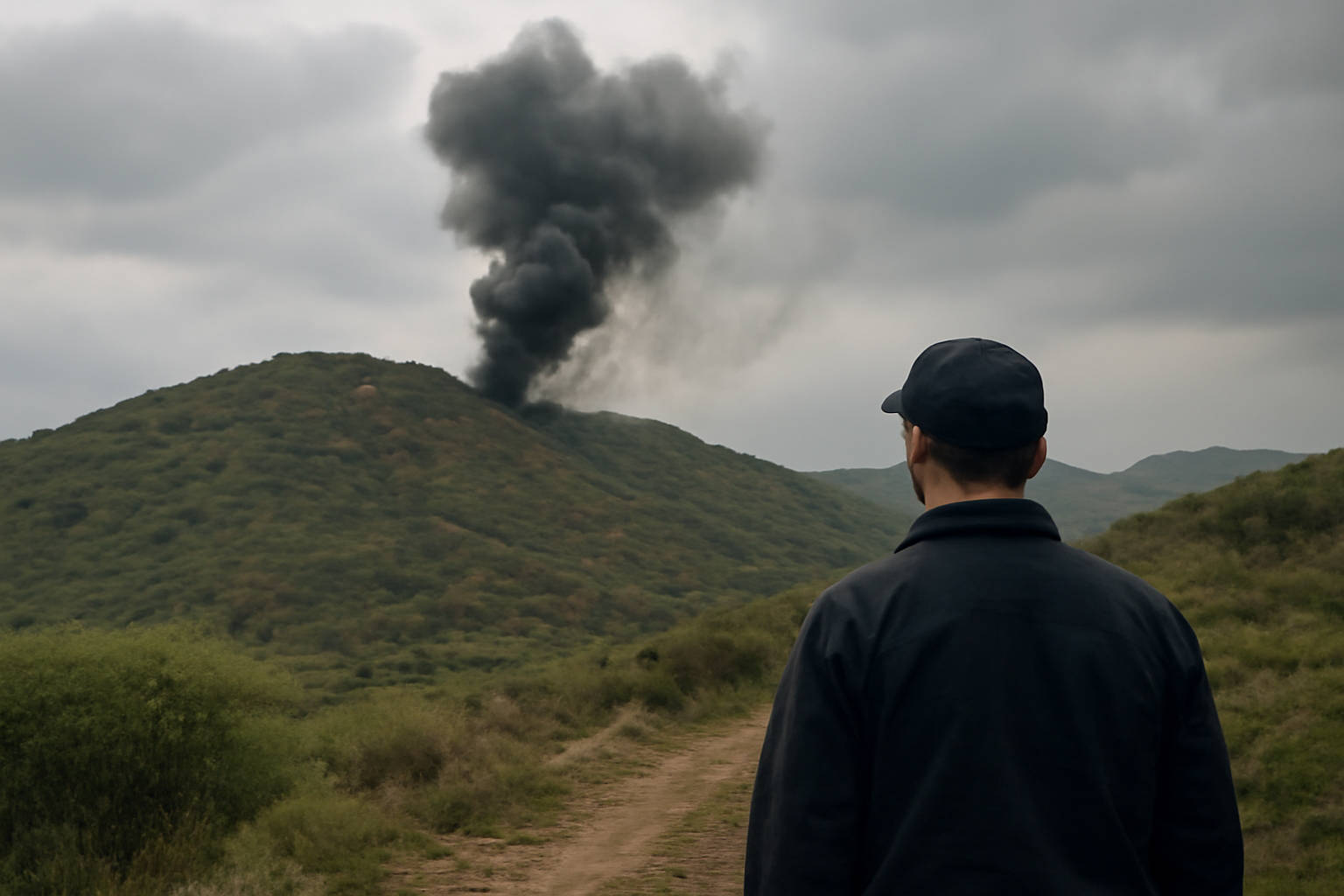
Former Chief of Defence Staff General Anil Chauhan has said an Indian loitering munition may have crashed in Pakistan’s Kirana Hills area during Operation Sindoor, after being sent to look for radar installations around Sargodha. The area is linked to facilities associated with Pakistan’s nuclear capabilities, making the account significant beyond the reported drone operation.
Chauhan’s remarks differ from a statement made during the conflict by Air Marshal A.K. Bharti, who said Indian forces had not attacked Kirana Hills or anything located there. The contrast has prompted renewed discussion about whether the reported impact was deliberate, accidental or the result of a munition exhausting its flight capability.
What General Chauhan said
Speaking at a discussion on Operation Sindoor and its aftermath at the Vivekananda International Foundation, a think tank associated with the Rashtriya Swayamsevak Sangh, Chauhan said India had sent several one-way explosive drones towards the Sargodha area before the attacks. Their purpose, according to his account, was to search for radars.
He said the weapons had a flight endurance of about two hours. If they did not find a target during that period, they would eventually descend and crash somewhere. Referring to Kirana Hills, Chauhan said one of the munitions may have struck one of the hills after reaching the area.
A loitering munition is an explosive drone that can fly over or near a target, search for it or wait for it, and then detonate by deliberately hitting the target. It is also commonly called a suicide drone.
Chauhan also referred to s shown in Pakistani media that appeared to show smoke rising from the area. His explanation was that any impact at Kirana Hills could have resulted from the munition’s flight limits rather than from an order to attack a nuclear-related site.
Earlier denial over Kirana Hills
During a media briefing on Operation Sindoor, Bharti was asked about Kirana Hills, which lies about 10 kilometres north of Sargodha. He said Indian forces had not attacked the hills or anything present there, adding that the question had informed him for the first time that the area contained a nuclear facility.
That earlier position was consistent with India’s stated account that the operation targeted terrorist infrastructure and conventional military sites, not Pakistan’s nuclear facilities. Reporting and open-source material cited in the discussion had not established firm evidence that India deliberately targeted a nuclear site.
The newer explanation has nevertheless left an unresolved point. Chauhan was reported as saying both that Kirana Hills was not targeted and that several loitering munitions had been sent towards Sargodha and Kirana Hills. The distinction between an intended target and an unintended impact is central to the competing interpretations of his remarks.
Claims about drones and radar systems
Pakistan’s military public-relations department had previously claimed that India sent Israeli-made drones into Pakistan and that its forces shot down 77 of them. Pakistani officials said the drones were brought down by different methods and identified them as Harop systems, which are made in Israel.
India, meanwhile, claimed that the drone attacks disabled several Pakistani defence radar systems, including one in Lahore. Pakistan rejected that claim. The material discussed in connection with Chauhan’s comments does not resolve the competing claims about the number of drones destroyed or the radar systems affected.
The reported location of the possible impact has added to the sensitivity of the issue. Pakistan’s Mushaf Air Base is described as being about 10 kilometres from Kirana Hills, while the surrounding area is widely associated with parts of Pakistan’s nuclear weapons infrastructure and stockpile. The proximity has led analysts to examine how a munition intended to suppress radar near the airbase could have reached a more sensitive location.
Analysts question the timing
Ankit Panda, a senior fellow in the Nuclear Policy Program at the Carnegie Endowment for International Peace, said Chauhan’s comments offered some clarity on an unresolved episode from the May 2025 India-Pakistan crisis. He wrote that an Indian loitering munition may have gone down near Kirana Hills, but argued that any such impact was likely unintended.
Panda said the episode highlighted the serious risk of an accidental escalation towards nuclear confrontation. In his account, the military conflict between India and Pakistan lasted about 88 hours and involved fighter aircraft, drones and other advanced weapons. Whether Kirana Hills had been deliberately attacked was one of the major disputes surrounding the conflict.
He also questioned why India would advance an account that could make it appear more willing to take risks, less precise and potentially careless. In his view, such an explanation could strengthen Pakistan’s argument that a conventional India-Pakistan confrontation can move rapidly towards nuclear danger.
Brahma Chellaney, a strategic affairs specialist, wrote on X that satellite s released soon after Operation Sindoor ended showed smoke and signs of impact at Kirana Hills. He said the location is broadly viewed as being connected to Pakistan’s nuclear weapons-related infrastructure and storage. Chellaney described Chauhan’s explanation as an assertion that any impact there was accidental and followed the exhaustion of the munitions’ battery capacity.
Christopher Clary, an associate professor at the University at Albany, also questioned why an explanation was considered necessary more than 15 months after the operation.
Debate over the Harop system
Defence analyst Rahul Bedi said he was also questioning the timing and believed the remarks would not strengthen India’s . He interpreted the setting and content of the comments as being aimed at domestic consumption and said he was concerned about the politicisation of the military.
Bedi said his understanding was that India had used an Israeli-made Harop as a loitering munition. He argued that if such a system was sent to strike a designated target, it would be expected to hit that target rather than shift to another one during the mission. He also said, based on his understanding, that the Harop could not be retargeted through a network while in flight.
That assessment conflicts with the possibility described by Chauhan: that a munition sent towards radar installations near Sargodha failed to find its intended target, remained airborne until its endurance ended and then struck terrain at Kirana Hills. The available accounts therefore leave the central question unsettled—whether the reported impact reflected the system’s operation, a targeting decision or facts that have not been publicly established.