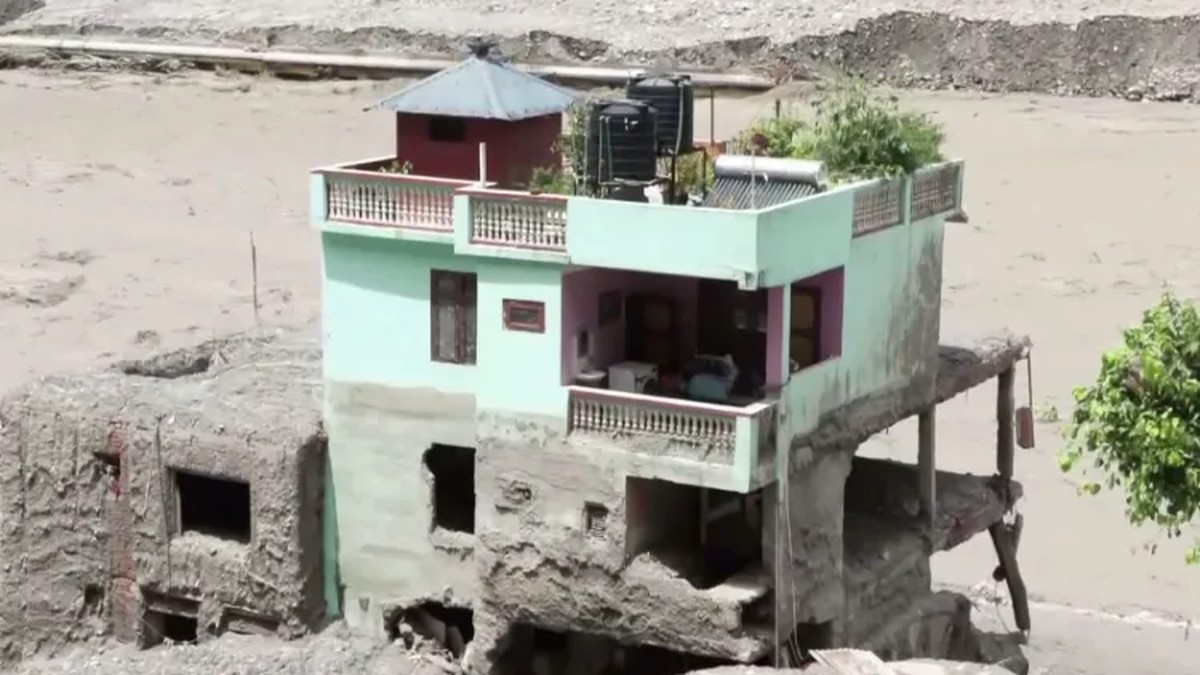
A 2-storey house remained standing during a destructive flood in Nepal, even as fast-moving water and debris swept through the surrounding area. Mud filled part of its lower floor, but the building did not collapse or get carried away by the current.
Videos showed vehicles moving through the water in front of the house, while large waves of debris and floodwater passed behind it. Several family members were seen on the upper floor as the flood surrounded the property. Their survival was later inferred from the building appearing intact, but it was not confirmed in the reported material.
Why the structure held
An architecture channel attributed the house’s strength to reinforced concrete construction (RCC). This type of structure uses concrete together with substantial steel reinforcement in elements such as columns, beams and slabs.
The explanation offered was that the steel-and-concrete frame helped transfer the force of the debris flow towards the foundation. Concrete is generally suited to resisting compression, while steel reinforcement helps a structure withstand tension and stress. Together, these materials can provide greater structural strength than a building made only from stacked stone.
The same assessment also noted the house’s position. The strongest part of the flood moved through the middle of the valley, while the property was located somewhat away from that main channel and at a slightly higher level.
What the explanation does—and does not—establish
An AI-based assessment found the basic engineering argument plausible, particularly the different roles played by concrete and steel. It also cautioned that some points in the explanation may have been based on assumptions.
The house’s survival therefore cannot be attributed to construction materials alone on the basis of the reported account. Its distance from the main current and its slightly elevated position were also presented as important factors.
Traditional houses in Nepal are often built by arranging mountain stones. The account said such structures can break apart when exposed to a powerful flood current. In areas considered vulnerable to flooding, people are increasingly building houses with concrete and steel reinforcement.
Conclusion
The house remained standing because its reinforced-concrete frame appears to have provided structural strength, while its location reduced exposure to the main flood channel. The precise condition of the people inside was not confirmed.
Frequently Asked Questions
Q. How did the house survive the Nepal flood?
The reported explanation points to reinforced-concrete construction and the house’s position away from, and slightly above, the main flood flow.
Q. What is RCC construction?
RCC means reinforced concrete construction, in which concrete is combined with steel reinforcement in structural elements such as columns, beams and slabs.
Q. What role did the steel play?
Steel reinforcement helps a structure withstand tension and stress.
Q. What role did the concrete play?
Concrete is well suited to resisting compression.
Q. Was the family inside the house confirmed safe?
No confirmation was provided. Their survival was inferred because the house remained standing.
Q. Why can some traditional houses be more vulnerable?
The account said stone-built houses can break apart when hit by a powerful flood current.
Q. Was the house directly in the main flood channel?
No. It was described as being somewhat away from the main flow in the valley and slightly higher than it.
Q. Are concrete-and-steel houses being built in flood-prone areas of Nepal?
The account said such construction is becoming more widespread in areas considered vulnerable to flooding.